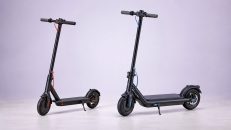
Quick answer: an electric scooter’s advertised range is a controlled-test estimate, not a guaranteed trip distance. Rider weight, speed, hills, stops, temperature, wind, tire pressure, battery condition, and riding surface can all reduce practical range.
Range, runtime, and battery capacity are different
- Range is distance, usually stated in miles or kilometers.
- Runtime is time under power, often stated in minutes.
- Battery capacity describes stored energy, commonly in watt-hours (Wh).
A scooter advertised for “40 minutes” does not automatically travel a predictable number of miles. Average speed, pauses, slope, and battery-voltage behavior affect the result.
Estimate battery energy
When voltage and amp-hour capacity are published, a simple estimate is:
Watt-hours = nominal volts × amp-hours
For example, a nominal 36 V, 10 Ah battery is approximately 360 Wh. This is a nominal figure; the controller does not make every watt-hour available, and real consumption changes continuously.
Why real-world range is lower
Rider and cargo weight
More mass requires more energy to accelerate and climb. Stay within the scooter’s maximum load, but remember that being under the limit does not guarantee the advertised range.
Speed and acceleration
Repeated hard acceleration and sustained high speed consume energy faster. A smoother pace and gradual starts generally extend range.
Hills and wind
Climbing and headwinds increase the motor’s workload. A route that looks short on a map may use much more battery than a longer flat route.
Stops and surface
Stop-and-go riding repeatedly spends energy on acceleration. Soft ground and rough pavement add rolling resistance. Regenerative braking, when present, does not recover all energy used.
Temperature and battery condition
Cold conditions can temporarily reduce available performance. Heat accelerates battery aging. An older or poorly stored pack may deliver less range than when new.
Tires and maintenance
Underinflated pneumatic tires increase resistance. Use the pressure and inspection schedule stated by the manufacturer; never inflate beyond the tire or scooter limit.
A safer way to plan a trip
- Start with a full charge completed according to the manual.
- Test the actual route in sections during safe conditions.
- Record distance, battery indication, temperature, load, and riding mode.
- Build a generous reserve rather than planning to arrive near zero.
- Identify a safe backup plan that does not depend on an unapproved charger.
Battery gauges are estimates and may drop faster under load. Do not use the last bar as a precise promise of remaining miles.
How to compare scooters by range
Look for a published test method: rider weight, speed or mode, terrain, temperature, tire pressure, and whether stops were included. Compare nominal battery energy as well as claimed distance. A heavier scooter with a larger battery may travel farther but be difficult to carry when depleted.
Also compare charger availability, charge time, electrical-system certification, replacement-battery support, total scooter weight, and warranty terms. Range alone is not a complete buying criterion.
How to preserve useful range
- Keep tires and brakes adjusted according to the manual.
- Use moderate acceleration and an appropriate riding mode.
- Avoid unnecessary load and do not exceed the weight limit.
- Store and charge the battery according to manufacturer instructions.
- Use only the supplied or manufacturer-approved charger and battery.
Read our electric scooter charging guide before changing any charging or storage routine. For broader buying factors, see the adult electric scooter guide.
Last reviewed: August 10, 2026.
A worked range-planning example
Suppose a manufacturer advertises 18 miles under test conditions. Do not plan a nine-mile outbound trip and assume the scooter will return. A heavier rider, frequent starts, a headwind, cold weather, low tire pressure, hills, and an aging battery can reduce the useful distance substantially.
Begin with a short repeatable route near home. Record the starting charge, distance, speed mode, temperature, hills, wind, rider load, and remaining charge. Repeat on several days. If the scooter reliably covers 10 miles in your conditions, reserve at least 20–30% instead of treating 10 miles as the trip target. In this example, a conservative planned route may be only 7–8 miles until more data are available.
Build a personal range log
- Date, temperature, and wind conditions
- Rider plus cargo weight
- Starting and ending charge indication
- Distance, elevation, surface, and speed mode
- Tire pressure and any battery or brake warning
A dashboard percentage can be an estimate rather than a laboratory measurement, so trends across several rides are more useful than one reading. Stop relying on old results after a battery replacement, long storage period, major temperature change, tire change, or firmware update.
When advertised range should not drive the purchase
Choose support, braking, fit, legal use, water-resistance guidance, tire service, and safe charging before chasing the largest range number. A long-range scooter that is too heavy to carry after a failure or too fast for the route can be the worse ownership choice. If a trip has no safe fallback, do not make it dependent on the maximum claimed range.
Range claims need a route fallback
Before a longer ride, identify safe places to stop and a realistic way to return if power drops early. Confirm that the rider can control the scooter without motor assistance where the manual permits it; some electric scooters are awkward or unsuitable to push for distance. Carrying a charger does not solve an unexpected shortage unless the stop is permitted, supervised, and suitable for safe charging.