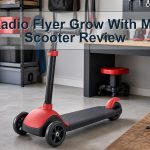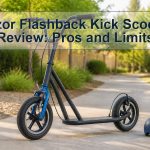
With $150, a family can buy a well-made kick scooter plus protective gear or an entry electric scooter with little money left for anything else. The right choice depends less on novelty and more on the child’s readiness, where they can legally ride, who carries it, and whether the family wants exercise or motorized recreation.
For most younger children, the kick scooter is the stronger value: lighter, simpler, easier to maintain, and better for learning balance and braking. An entry GOTRAX GKS can fit near the cap during sales, but the AAP recommends no e-scooter riding under 16 and the electric purchase adds battery, charger, storage, and supervision responsibilities.
Quick Answer
Choose a kick scooter under $150 for most children. It leaves money for helmet and pads, weighs less, has no charging risk, and develops propulsion and braking skills. Consider an electric option only for a measured, legally eligible rider after accepting the AAP caution and full ownership cost.
Best Options at a Glance
- Best overall family value: quality adjustable kick scooter plus gear.
- Best stability-first format: three-wheel kick scooter for younger riders.
- Electric reference near the cap: GOTRAX GKS during a verified sale.
- Best reason to wait: no legal private riding space or no gear budget.
Kick Scooter Package — Best Complete Setup
Kick propulsion naturally limits continuous speed and teaches the child to balance, scan, push, coast, and brake. The format is not risk-free, but it avoids electrical and charging hazards and is easier to carry home.
Good reasons to choose it
- More of the budget remains for gear.
- Usually much lighter than an electric scooter.
- Low maintenance and no battery storage.
- Builds skills useful before any powered ride.
Reasons to pause
- Requires physical effort and may not suit every mobility need.
- Small wheels still struggle on rough surfaces.
- Fast downhill riding remains dangerous.
Decision: Best for most children and first-time scooter families.
Check exact model and seller: [AFF-LINK]
GOTRAX GKS — Electric Reference Near $150
Official source: GOTRAX GKS. Terms, stock, and pricing can change; read the live document before purchase.
The GKS is a credible entry model, not a complete $150 package. Tax and gear move the true cost higher, and the fixed bar can shorten useful life. Its battery and 90-day kids warranty add responsibilities a kick scooter does not.
Good reasons to choose it
- Restrained 7 mph maximum.
- Recognizable model with manual and support.
- Light relative to many powered scooters.
Reasons to pause
- Consumes nearly all of the scooter budget.
- Fixed bar and firm solid tires.
- Charging, battery, and warranty management required.
- AAP recommends no e-scooter riding under 16.
Decision: Only for a family treating $150 as the scooter price rather than the total setup.
Check exact model and seller: [AFF-LINK]
Used Electric Scooter — Usually the Wrong Shortcut
Official source: CPSC recall search. Terms, stock, and pricing can change; read the live document before purchase.
The savings are hard to value without diagnostics and service history. A battery that has been deeply discharged or stored hot can fail after the return opportunity disappears.
Good reasons to choose it
- Potentially higher original specification for the money.
- Local pickup can allow visual inspection.
Reasons to pause
- Battery history is invisible.
- Warranty may not transfer.
- Wrong or generic charger is common.
- Hidden repairs can exceed the savings.
Decision: Skip unless an experienced adult can verify the exact model, recall status, battery, charger, frame, brakes, and ownership record.
Compare the Two Formats by Daily Reality
A 7-pound kick scooter is easy to carry when the child stops riding. A 18–25-pound electric scooter changes stairs, car loading, school storage, and recovery after a flat or empty battery.
Kick scooters need tire, bearing, latch, and brake inspection. Electric models add cells, wiring, controller, motor, charger, connector, and fire-safe storage. That extra complexity should solve a real family need.
If the child cannot stop and scan reliably on a kick scooter, adding power does not solve the skill gap. Practice on the simpler format first.
Before you pay
- Reserve gear money before selecting the scooter.
- Confirm legal riding location and minimum age.
- Measure bar, deck, payload, and brake reach.
- Compare carrying weight and storage space.
- Price approved charger and replacement parts.
- Choose kick power when the child still needs basic skills.
- Never use a faster electric model merely for growth room.
Budget for the Whole Ownership Cycle
The scooter price is only the first line. Add a properly fitted helmet and pads, tax, any necessary lock or visibility gear, approved replacement parts, and eventual battery decline. Do not use a generic charger to save money; matching connector shape does not prove correct voltage, current, polarity, or protection.
Keep the receipt, serial number, box label, manual, and photos from delivery. Inspect the charger, battery area, brakes, tires, stem, fasteners, and folding latch before each ride. Store and charge in a dry, ventilated place away from exits and combustible materials while an adult is awake.
Frequently Asked Questions
Is an electric scooter more fun than a kick scooter?
Some children prefer powered acceleration, while others enjoy pushing, tricks, or neighborhood play. Fun does not replace fit, readiness, law, supervision, or the safety budget.
Which lasts longer under $150?
A quality kick scooter usually has fewer expensive failure points. An entry electric scooter may lose useful life through battery aging or fixed geometry even when the frame looks fine.
Can a child commute on either one?
Check local law, school policy, route traffic, storage, and the AAP recommendation. A recreational product label does not make a public route appropriate.
Should siblings share one scooter?
Only if both fit the same bar, deck, payload, and brake, and the family adjusts and inspects it for each rider. One rider at a time—never passengers.
Bottom Line
Under $150, a quality kick scooter plus protective gear is the better complete purchase for most children. The GKS is a credible electric reference near the cap, but the real setup costs more and carries more responsibility. Buy motor power only when it solves a defined need, not because it is available.
Editorial basis: This is research-based comparison, not hands-on testing. Current product, warranty, and safety statements were checked on August 10, 2026 against manufacturer documents, the AAP e-scooter guidance, the CPSC UL standards notice, and the CPSC recall database. Confirm the exact model, seller, price, warranty, charger, and local rules at purchase.