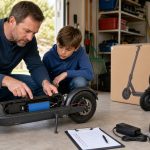
Learning how to fold a Razor scooter starts with one detail people often skip: identify the exact model. A classic A-series side-release mechanism, an A5 Air or A6 anti-rattle knob, a junior folding design, and a non-folding stunt scooter do not use the same sequence. Forcing the wrong part can pinch fingers, bend hardware, or leave the stem partly locked.
The safe method is model-first: read the label, open the matching Razor manual, place the scooter on stable ground, keep everyone clear of the hinge, release only the documented controls, move the stem without force, and verify the riding lock before anyone steps on.
Before You Touch the Hinge
- Read the model and product ID label.
- Download that model’s official owner manual.
- Turn off an electric model and remove its charger.
- Move to flat ground with the scooter stationary.
- Keep children, clothing, and fingers away from pivot gaps.
- Remove bags or locks that pull on the handlebar.
Need replacement safety gear or the exact manufacturer-approved part? [AFF-LINK]
Razor’s support library separates A-type, A5 Air, A5 Lux, A6, junior, electric, and Pro Series manuals. Similar-looking scooters may contain different latches. If the label is missing or the hinge is damaged, do not learn by trial and error.
Identify Your Razor Folding System
Classic folding lever
Many compact A-series scooters use release levers near the front hinge. The rider unloads the stem, moves the documented lever, and pivots the T-tube. Lever count and direction vary, so photos from another model are not enough.
Anti-rattle knob system
Current A5 Air and A6 manuals describe an anti-rattle knob that must be loosened before its spring-loaded release can move. Razor says a partial turn is sufficient on some versions and warns against overtightening after unfolding.
Non-folding design
Stunt scooters and the Flashback are examples of designs that may be rigid. A clamp at the base of a bar is not automatically a folding control. Never loosen structural compression or bar-clamp bolts to imitate a transport hinge.
How to Fold an Anti-Rattle Razor Scooter
Use this sequence only after confirming it matches the manual. Stand beside the scooter rather than over the hinge. Hold the T-bar so it cannot drop. Turn the anti-rattle knob counterclockwise only as instructed—Razor’s A6 guidance says it need not be loosened more than about one full turn.
- Keep weight off the deck and stem.
- Loosen the anti-rattle control.
- Pull or slide the spring-loaded knob in the documented direction.
- Guide the T-bar down slowly while maintaining the release.
- Let the mechanism enter its folded position without slamming.
- Confirm the scooter will not unfold while being carried.
Official example: Razor A6 manual
How to Unfold an Anti-Rattle Model
Place the wheels and deck on the ground. Pull or slide the release as the manual shows, then raise the T-bar smoothly until the primary mechanism locks upright. Do not use momentum to make it click.
Razor’s A5 Air/A6 instructions then call for tightening the anti-rattle knob clockwise to engage that feature, without overtightening. The primary riding lock and the anti-rattle adjustment are related but not interchangeable: reducing play does not prove the hinge is latched.
How to Handle Classic Side Levers
On a confirmed classic A-style model, stabilize the scooter and move only the manual-identified release. If a lever is difficult, change stem pressure slightly so the latch is not loaded; do not kick, hammer, extend it with a tool, or spray lubricant into the mechanism blindly.
Why a lever may feel stuck
The hinge can be carrying the bar’s weight, grit may be packed around it, or a bent part may be binding. Wipe external debris with a dry cloth and try again with the stem supported. Persistent resistance, cracks, misalignment, or a missing spring needs service—not more force.
Handlebars and Height Buttons
Some Razor scooters have removable left and right grips secured by spring buttons. The A6 manual warns that both buttons must be clearly visible through their holes and that incorrectly engaged handlebars can move or dislodge while riding.
The height-adjustment button and quick-release clamp also need a positive lock. Folding the base does not verify the upper bar. After transport, check the hinge, bar height, clamp, and both handlebar buttons as separate items.
The Six-Point Unfolded Test
- The main hinge is fully in its upright detent.
- The anti-rattle knob is engaged only to manual guidance.
- The height button is visible in a complete hole.
- The quick-release clamp is closed with appropriate tension.
- Both removable handlebar buttons are visible and grips do not rotate.
- A gentle forward, backward, and sideways hand test reveals no collapse or abnormal play.
Perform this test before every ride, not only after travel. CPSC recommends making sure handlebars and steering columns are securely locked and checking nuts and bolts routinely.
If the Scooter Will Not Fold
Stop if the model is uncertain
Find the product ID and manual. Do not follow a short social video that omits the model. A rigid Pro Series scooter is supposed to resist folding.
Unload the latch
Support the stem and remove pushing or pulling pressure from the hinge while operating the release. Mechanisms often bind when the rider is accidentally levering against the latch.
Inspect rather than force
Look for stones, bent metal, a cracked housing, rust, missing hardware, or a release that does not spring back. Contact Razor support or a qualified shop. Never ride a mechanism that was freed with impact or excessive force.
If the Scooter Will Not Stay Unfolded
Do not let anyone stand on it. A primary latch that does not engage, a spring-loaded button hidden below a hole, or a clamp that opens by itself is a fall hazard. Moving the anti-rattle knob tighter cannot repair a broken lock.
Photograph the product ID and problem, compare hardware with the parts diagram, and request model-correct support. Do not drill a new hole, add a generic bolt, tie the stem upright, or tape the hinge.
Folding an Electric Razor Scooter
Only fold a model whose official manual describes folding. Switch power off, disconnect the charger, and keep controls and cables from snagging. Electric stems may be heavier and can fall more forcefully through the hinge.
Never lift an electric scooter by a display, throttle, brake cable, or loose folding stem. After unfolding, confirm cables are not pinched, twisted, stretched, or routed into the wheel. Complete a powered systems check only after the mechanical lock passes.
Common Mistakes
- Assuming every Razor uses the same lever.
- Putting fingers inside the hinge path.
- Forcing a loaded or non-folding mechanism.
- Using anti-rattle tension as proof of primary lock.
- Ignoring upper bar buttons after the base is unfolded.
- Carrying a scooter before its folded position is secure.
- Riding immediately without a stationary lock test.
Safety Rules
Wear a properly fitted helmet and protective gear for the subsequent test ride. Use flat, dry, traffic-free pavement. Begin at walking speed, brake several times, and recheck the hinge before normal riding.
Frequently Asked Questions
Why will my Razor scooter not fold?
The latch may be loaded, the anti-rattle feature may still be engaged, grit or damage may be binding it, or the model may be non-folding. Confirm the manual first.
Should I oil the folding joint?
Only if the exact manual or Razor support specifies the product and location. Random oil can attract grit, reach brakes, or hide damage.
How do I know it is safely unfolded?
The primary latch must engage positively; every bar button and clamp must lock; and a stationary hand test must show no collapse or abnormal play.
Can I fold a Razor stunt scooter?
Usually no. Stunt scooters commonly use rigid bars and compression systems. Never loosen structural clamps to create a fold.
Final Checklist
Model, manual, clear hinge, unloaded latch, controlled movement, positive lock, upper-bar check, stationary test, then walking-speed ride. That order makes folding routine without turning a convenience feature into a structural guess.