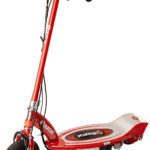
Current assessment: the Razor E300 is a large, heavy, high-speed recreational electric scooter that Razor lists for ages 13 and up in current official materials. It is not a “little kid” scooter, and a manufacturer age label alone does not establish readiness.
The American Academy of Pediatrics recommends that children under 16 should not operate or ride motorized or e-scooters. Parents should consider that more conservative guidance, the exact manual, local law, fit, maturity, and riding environment.
Razor E300 key specifications
- Manufacturer age guidance: 13+
- Claimed top speed: up to 15 mph (24 km/h)
- Claimed runtime: up to 40 minutes of continuous use
- Recommended maximum rider weight: 220 lb (100 kg) on the referenced current product specification
- Battery: 24 V sealed lead-acid system
- Tires: pneumatic front and rear
- Controls: twist-grip acceleration and hand-operated rear brake
Specifications can vary by market and generation. Confirm the label and manual supplied with the exact scooter rather than using an older review as the final source.
Who should consider it?
The E300 may suit a rider who meets the applicable guidance, fits the full-size frame, can control a 15 mph-class scooter, has a permitted closed riding area, and can manage its substantial weight. It is a poor choice when easy carrying, compact storage, low-speed beginner control, or public-street legality is the main need.
Fit and readiness questions
- Can the rider hold the scooter upright and move it safely when powered off?
- Can they reach the throttle and brake without changing grip?
- Can they start, turn, scan, and stop smoothly on a non-motorized scooter?
- Will they follow a fixed riding boundary and stop on command?
- Is the route flat, dry, away from traffic, and allowed by the manual and local rules?
Use our electric scooter age and readiness guide before deciding.
Ride quality and ownership tradeoffs
The large frame and pneumatic tires can feel more substantial than smaller E-series scooters, but the steel construction and sealed lead-acid battery make the E300 heavy. Runtime and speed are “up to” claims affected by rider weight, slope, tire pressure, surface, temperature, and battery condition.
Chain-driven versions require inspection and maintenance according to the manual. Replacement parts must match the exact version.
Charging and storage
Use only the supplied or manufacturer-approved charger. Remain present while charging, never charge while sleeping, unplug when complete, and stop using a damaged or unusually hot battery system. Follow our safe charging checklist.
Safety requirements
Wear a properly fitted helmet, closed-toe shoes, and appropriate protective gear. Use one rider only. Inspect tires, brake, throttle, cables, frame, steering, and battery enclosure before riding. Avoid traffic, wet surfaces, gravel, steep slopes, and visibility-poor conditions.
Verdict
The E300 should be evaluated as a fast, full-size recreational scooter—not as a default children’s model. Its strongest case is for an appropriately mature, properly fitted rider in a controlled and permitted environment. The age label, claimed speed, and load limit are screening data, not proof of suitability.
Compare other Razor models in the Razor scooter review hub and read the complete scooter safety guide.
Sources
- Razor E300 official product specifications
- Razor E-Series manuals and support
- AAP e-scooter guidance
Specifications and guidance checked: August 10, 2026.
For high-capacity alternatives and smaller age categories, compare the E300 in our 2026 kids electric scooter roundup.
What the classic E300 specification means in practice
Razor’s current global E300 information lists ages 13+, a maximum rider weight of 220 lb, speed up to 15 mph, and runtime up to 40 minutes of continuous use. It describes a large steel frame and deck, twist-grip throttle, hand-operated rear brake, pneumatic front and rear tires, retractable kickstand, and a 24V sealed lead-acid battery system. These are manufacturer claims and can vary by version or market.
Fifteen miles per hour is not an entry-level pace. The rider needs space to accelerate gradually, scan well ahead, and stop without an abrupt weight shift. The larger frame and pneumatic tires can improve room and comfort compared with smaller E-series models, but the scooter is also heavier to carry and more demanding to store.
Verify the exact E300 before buying used
The E300 name has existed for many years. Photograph the product ID, battery label, charger label, control layout, and frame before ordering parts. Compare them with the correct manual in Razor’s E-series support library. Razor also maintains a historical recall notice for select E300 units made from December 2005 through September 2006; check the product ID rather than assuming every E300 is affected.
Ownership costs and disqualifiers
- Budget for tire pressure checks, tubes or tires, brake adjustment, and eventual sealed lead-acid battery replacement.
- Use only the correct Razor-approved charger for the exact battery configuration.
- Do not plan a commute around the maximum runtime claim.
- Skip a used unit with missing labels, a generic charger, altered wiring, corrosion, swelling, crash damage, or an uncertain recall history.
The E300 is best treated as a heavier recreational electric scooter for an appropriately sized older rider in a controlled permitted area. It is a poor choice when portability, low beginner speed, or compact indoor storage is the priority. See the official Razor E300 specification for the current manufacturer snapshot.
Use a controlled used-E300 demonstration
After confirming the product identity, correct charger, recall status, and static condition, test a used E300 in a private flat area with an appropriately capable rider. Begin with slow acceleration, straight tracking, brake response, tire behavior, and unusual noise. Stop if power cuts out, the brake changes feel, steering shifts, or the battery enclosure becomes unusually warm.
Record the charge indicator and duration, but treat one demonstration as a screening step—not proof of maximum range or remaining battery life.