Short verdict: the E100 family is the smaller, slower class, while the current E200/E200S class uses a larger frame, higher stated speed, and older minimum-age guidance. These are not interchangeable “upgrade levels” for every child; fit, pediatric guidance, local rules, and the exact product version come first.
Important: Razor sells multiple E100 variants, and the currently listed U.S. E200 page is the seated E200S. The table below uses Razor’s current Black Label E100 and E200S pages as a transparent reference. Confirm the exact box, product page, and manual before purchase.
Razor E100 vs E200S specifications
| Specification | Black Label E100 | E200S |
|---|---|---|
| Manufacturer age | 8+ | 13+ |
| Claimed top speed | Up to 10 mph | Up to 12 mph |
| Claimed runtime | Up to 35 minutes | Up to 40 minutes |
| Recommended max weight | 120 lb | 154 lb |
| Motor | 90 W rear hub, kick-to-start | 200 W chain drive |
| Controls | Thumb throttle; front hand brake plus rear fender brake | Twist throttle; hand-operated rear brake |
| Tires | 8-inch pneumatic front; 6-inch airless rear | 8-inch pneumatic front and rear |
| Battery | 12 V sealed lead-acid | 24 V sealed lead-acid |
What the differences mean
The E200S is physically larger, heavier, and faster, with a higher stated load limit and a seat. The Black Label E100 uses kick-to-start activation, a smaller power system, and two braking surfaces. Neither specification sheet tells you that a particular rider is ready.
Rider weight, slope, tire condition, charge, temperature, and surface affect speed and runtime. Treat “up to” figures as manufacturer test claims rather than guaranteed results.
Age guidance requires context
Razor currently labels the compared E100 variant 8+ and the E200S 13+. The American Academy of Pediatrics recommends that children under 16 should not operate or ride motorized or e-scooters. Parents should weigh the more conservative pediatric guidance, local law, the manual, and the child’s ability rather than relying on a product age label alone.
Choose based on these questions
- Does the rider meet all applicable guidance and legal requirements?
- Can they reach, modulate, and release the throttle without looking down?
- Can they brake smoothly and stop on command?
- Does the frame and control position fit their body now?
- Is there a flat, dry, closed practice area away from traffic?
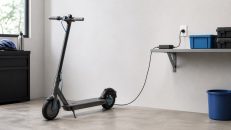
- Will an adult control charging, inspection, and storage?
Safety and ownership
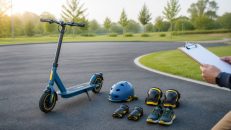
Use a properly fitted helmet and protective gear, one rider at a time, and the riding locations allowed by the manual and local law. Inspect tires, brakes, controls, frame, and wiring before riding. Use only the supplied or manufacturer-approved charger.
Read the age and readiness guide, safety checklist, and charging guide.
Sources
Specifications checked: August 10, 2026. Product details can change.
For Segway, GOTRAX, Hiboy, Globber, and other Razor options, continue to our electric scooter picks for kids by age.
Decision matrix: E100 or E200-family model?
| Question | E100 direction | E200-family direction |
|---|---|---|
| Is the rider still learning powered starts and stops? | The lower-speed class may be easier to introduce, subject to readiness and current specs. | Do not move up merely for future growth. |
| Does the rider need more deck room or pneumatic tires front and rear? | Check the exact E100 version; configurations vary. | The current compared E200S specification may better match, but verify the exact listing. |
| Can the family store and carry a heavier scooter? | Usually the easier class to manage. | Measure storage and lifting requirements first. |
| Is 12 mph appropriate for the route and rider? | Do not exceed a rider’s demonstrated control. | If no, the E200-family speed is a disqualifier, not a benefit. |
What ownership feels like after the first ride
Both names refer to product families with version changes over time. Owners need to maintain tires where pneumatic, test the brake, keep the steering secure, use the correct charger, and plan for eventual battery wear. The larger model can be harder to carry when the battery is empty. Before purchase, ask who will move it, where it will charge, and whether the route is permitted.
Used E100/E200 inspection
- Match the product ID label to the correct Razor manual and support page.
- Confirm the charger model and output match the exact battery system.
- Inspect the frame, fork, deck, steering, wiring, tires, and brake for alteration or damage.
- Check current recall information by product identity, not only the model name.
- Walk away from missing labels, generic chargers, corrosion, swelling, exposed wiring, or unreliable braking.
Our practical verdict
Choose neither until the rider passes the readiness checks and the family confirms local use. If powered riding is appropriate, prefer the slowest model that fits now and supports predictable control. The E200-family model makes sense only when its extra speed, size, and ownership burden solve a real problem for a capable rider.
Because the AAP recommendation for children is more conservative than some manufacturer labels, parents should weigh that medical guidance alongside the current manual. A manufacturer minimum age is not a guarantee of individual readiness.