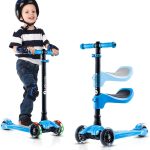
Short answer: there is no single age that makes every child ready for an electric scooter. Manufacturer limits, the scooter’s speed and controls, local law, and the child’s judgment all matter. The American Academy of Pediatrics (AAP) recommends that children under 16 should not operate or ride motorized or e-scooters.
That pediatric guidance is more conservative than the age labels on some youth products. A product being sold for a younger age group does not remove the need to consider medical guidance, local rules, supervision, and the child’s real ability.
Start with four separate checks
- Authoritative safety guidance: read the AAP guidance on children and e-scooters.
- Manufacturer instructions: confirm the exact model’s minimum age, maximum rider weight, speed modes, protective gear, and permitted riding conditions.
- Local law: check the official state, provincial, city, or national source. Rental-scooter rules may differ from privately owned scooters.
- Individual readiness: assess balance, braking skill, attention, impulse control, and willingness to follow limits.
Readiness checklist for parents
A rider should already be confident on a non-motorized scooter or bicycle and demonstrate all of the following before a parent even considers a motorized product:
- keeps both hands on the handlebars;
- looks ahead rather than down at the front wheel;
- brakes smoothly without panic;
- understands stopping distance increases with speed;
- recognizes driveways, vehicles, pedestrians, pets, and uneven surfaces as hazards;
- can follow a fixed riding boundary and stop immediately when told;
- accepts a helmet, closed-toe shoes, and other protective equipment every time;
- fits the scooter and can reach every control comfortably.
If any item is uncertain, stay with a correctly sized kick scooter and supervised practice. Our kids scooter size guide can help with non-motorized fit.
Why speed changes the decision
Motor power, wheel size, surface, slope, load, battery charge, and speed mode can change how quickly a scooter accelerates and stops. Even a product marketed for children may move faster than a beginner expects. Small wheels can also react sharply to cracks and debris.
Do not choose a scooter simply because its top speed sounds low. Check whether the child can modulate the throttle, use the brake without changing hand position, put a foot down safely, and remain calm when the scooter surges or encounters an obstacle.
Manufacturer age labels: minimum, not a guarantee
Age recommendations differ across models. For example, Razor currently lists its E200S for ages 13 and up, while the Pocket Mod Classic has separate low- and high-speed guidance. These model-specific labels can change, so confirm the current product page and manual before buying.
Never use customer reviews claiming that a younger child “rides it fine” as evidence of readiness. Another child’s height, judgment, experience, supervision, and riding environment may be completely different.
Where a beginner should practice
If the rider meets the relevant guidance and rules, begin in a dry, flat, closed area away from traffic and pedestrians. Use the lowest speed mode available. Practice starting, straight-line braking, controlled turns, scanning, and emergency stopping before extending the riding area.
One adult should supervise without distraction. Do not allow passengers, phones, earbuds, night riding, wet-surface riding, or public-road use unless the product and local law explicitly permit it.
Questions to answer before buying
- What does the exact manual say about age, weight, gear, and riding location?
- What is the lowest usable speed mode?
- Can the rider reach and operate the brake while maintaining control?
- Is the electrical system certified to an applicable safety standard?
- Are manufacturer-approved replacement parts and a correct charger available?
- Where can the scooter legally and safely be ridden?
- Who will supervise, inspect, charge, and store it?
Bottom line
Treat age as one part of a safety decision, not the decision itself. Give greater weight to pediatric guidance, official local rules, the exact manual, and observable readiness. When those signals conflict, choose the safer option or wait.
Continue with the site-wide scooter safety guide and safe charging guide.
Reviewed against current AAP, CPSC, and manufacturer guidance: August 10, 2026.
Once you have completed the readiness checks, use our age-by-age kids electric scooter comparison to compare speed, fit, brakes, and limits.
Run a readiness observation before spending money
Use a non-powered scooter or bicycle in a traffic-free area and observe the child for 15–20 minutes. Ask them to start only on a signal, ride a straight line while scanning ahead, slow before a marked line, stop at the line, look over a shoulder without swerving, and stop immediately when an adult calls. Repeat the sequence after the excitement of the first few minutes has passed.
Readiness is not proven by one successful stop. Look for repeatable control, willingness to follow boundaries, and the judgment to slow down without being reminded. A child who freezes, accelerates when surprised, watches the front wheel, or argues about the practice boundary is not ready for added motor power.
Automatic reasons to postpone an electric scooter
- The rider cannot reach and operate every control without shifting their grip.
- The family does not have a legal, dry, low-conflict practice area.
- No adult can supervise the learning sessions and charging routine.
- The scooter’s slowest available mode is still faster than the rider can manage.
- The product identity, manual, charger, battery condition, or recall status is uncertain.
Postponing is a safety decision, not a punishment. A well-fitted kick scooter can build steering, scanning, braking, and boundary skills while the family reassesses later.