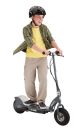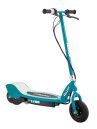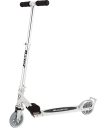
Short verdict: choose the Razor A for the lowest weight and simplest setup, the A2 for the same 95 mm wheel size plus front vibration-dampening suspension and a wheelie bar, or the A3 for larger 120 mm wheels, suspension, and a slightly larger platform.
This comparison uses current Razor U.S. product specifications. Colors, pricing, and product details can change, so verify the exact listing and manual.
Razor A vs A2 vs A3 specifications
| Specification | Razor A | Razor A2 | Razor A3 |
|---|---|---|---|
| Manufacturer age | 5+ | 5+ | 5+ |
| Recommended max weight | 143 lb | 143 lb | 143 lb |
| Wheel size | 95 mm urethane | 95 mm urethane | 120 mm urethane |
| Front suspension | No | Springless | Springless |
| Wheelie bar | No | Yes | Yes |
| Deck | 17.3 × 3.6 in | 17.3 × 3.6 in | 19.5 × 3.6 in |
| Product weight | 4.62 lb | 5.35 lb | 7.02 lb |
| Brake | Rear fender | Rear fender | Rear fender |
Razor A: best when low weight matters
The original A model is the simplest and lightest of the three. Its 95 mm wheels, folding aluminum frame, adjustable bars, and rear-fender brake make it easy to carry. The tradeoff is that it lacks the vibration-dampening fork and wheelie bar found on the A2 and A3.
Razor A2: small wheels plus suspension
The A2 retains 95 mm wheels and the same published deck size as the A, but adds springless front suspension and a wheelie bar. It weighs modestly more. That makes it the middle option for riders who want the compact A-series feel with additional vibration damping.
Razor A3: larger wheels and deck
The A3 uses 120 mm wheels and a longer deck. Larger wheels generally roll more easily over small surface imperfections, while the larger scooter weighs more to carry. It also includes front vibration-dampening suspension and a wheelie bar.
Which one should you choose?
- Choose A for the lightest carry weight and simplest design.
- Choose A2 for suspension while keeping 95 mm wheels and a compact deck.
- Choose A3 for 120 mm wheels and a longer deck, provided the scooter fits the rider.
Do not choose by age label alone. Check handlebar position, deck space, brake control, scooter weight, and the child’s skill. The rider must stay within the stated limit and be large enough to control the scooter. Use our kids scooter size guide.
Safety notes
Razor says to wear protective equipment, ride on smooth paved surfaces away from motor vehicles, avoid wet or debris-covered surfaces, inspect before each ride, and check local laws. A wheelie bar does not make tricks risk-free. Practice only in a suitable area after basic starting, steering, and braking are reliable.
See our individual Razor A, Razor A2, and Razor A3 reviews, plus the scooter safety guide.
Official sources
Specifications checked: August 10, 2026. Product details can change.
Decision matrix: Razor A, A2, or A3?
| Priority | Best starting point | Why |
|---|---|---|
| Lowest carrying weight and simplest format | Razor A | Start here when portability matters more than added features. |
| Small-wheel format with front vibration damping | Razor A2 | The suspension feature may soften some vibration but cannot make rough ground suitable. |
| Larger wheels and a larger deck within this group | Razor A3 | May suit a rider wanting more roll-over ability and standing room, subject to measured fit. |
Run a fit test instead of buying by age
Set the bars so the rider stands upright with relaxed elbows and secure hands. Confirm there is enough deck space for a stable stance and that the child can use the rear fender brake without losing balance. Then ask for repeated push, glide, turn, and stop attempts on a dry, level surface.
The A3’s larger wheels do not automatically make it right for a smaller rider, and the A’s lower weight does not help if the bars or deck do not fit. Compare the minimum and maximum handlebar positions, folded size, scooter weight, and rider limit on the current official product pages.
Surface and portability trade-offs
All three are small-wheel kick scooters intended for relatively smooth surfaces. Front suspension on the A2/A3 can reduce some vibration, but it does not remove the stopping risk created by holes, gravel, wet pavement, or large cracks. Larger wheels may roll over small imperfections more easily, while a lighter scooter is easier for a parent or child to carry when riding ends.
Fold and unfold the scooter with adult supervision until the locking mechanism is understood. Check that the mechanism fully engages before every ride and keep fingers clear of pinch points.
Used-scooter inspection and final verdict
- Check steering alignment, folding-lock security, wheel spin, axle play, deck damage, grips, bar ends, and brake return.
- Confirm the handlebar adjustment locks at the rider’s correct height.
- Skip a scooter with a bent fork, cracked deck, loose folding joint, missing fasteners, or persistent wheel wobble.
Choose the A when simple portability is the clear priority, the A2 when its specific small-wheel suspension format fits the rider, and the A3 when measured fit supports its larger-wheel, larger-deck direction. If two models fit equally well, the simpler and lighter option is often the easier family choice.
For broader sizing help, use the kids scooter size guide and verify every current Razor specification before ordering.