The best electric scooter for kids ages 8–12 is not one model for every child. An eight-year-old who is learning throttle and brake control has different needs from a tall twelve-year-old who has already mastered a kick scooter. Height, weight, judgment, practice area, and the scooter’s slowest mode matter more than the birthday printed on a listing.
This guide is for families comparing one adjustable scooter across siblings or narrowing a broad age range before reading a single-age guide. Our best overall research pick is the Segway Ninebot C2 Pro because its three handlebar heights and parent-controlled speed limit make it unusually adaptable. For a lighter, smaller rider, the C2 Lite is easier to carry; for a deliberately slower ceiling, the GKS Lumios is the clearer option.
Quick Answer
Choose by measured rider height and demonstrated skill. The C2 Pro has the widest growth range, while the C2 Lite favors smaller 8–10-year-old dimensions. The GKS Lumios trades speed and range for a slower 7.5 mph ceiling. Do not buy the fastest model merely to avoid an upgrade later.
Quick Picks
- Best adjustable: Segway Ninebot C2 Pro.
- Best compact: Segway Ninebot C2 Lite.
- Best low-speed adjustable: GOTRAX GKS Lumios.
- Best traditional controls: Razor Power Core E100.
- Best folding 10 mph alternative: GOTRAX T7.
Segway Ninebot C2 Pro — Best Adjustable Pick
Official specifications: Segway C2 Pro
The C2 Pro is the most flexible family choice because its bar spans three positions and its app can reduce the maximum speed for a less experienced sibling. That adjustability makes it more useful across ages 8–12 than a fixed youth frame.
What to check: Use the U.S. manual and specifications for a U.S. purchase. Regional versions publish different speed, range, payload, and age figures. Lock the speed below the 12.4 mph maximum.
What parents may like
- Three handlebar positions cover a wide range of rider heights.
- Parent-controlled maximum speed is available through the Segway app.
- Folding stem helps with car and closet storage.
- Display, drum brake, and published test conditions support informed comparison.
Limitations
- The full 12.4 mph setting is too aggressive for a new rider.
- Bluetooth audio and decorative lights add cost without improving control.
- No suspension, and regional specifications differ.
Best fit in this guide: Growing riders within the published height and payload limits, especially households sharing one scooter.
Affiliate link: [AFF-LINK]
Segway Ninebot C2 Lite — Best Compact Low-Weight Pick
Official specifications: Segway C2 Lite
For the younger and smaller end of this range, the C2 Lite avoids the bulk of a teen-style scooter. Its mode structure and light chassis are more meaningful than extra motor power.
What to check: The fixed 37.4-inch overall height and 4′8″ rider-height ceiling mean many older children will outgrow it. Confirm fit now rather than buying from the age label alone.
What parents may like
- Light 17.2-pound body is easier for an adult to carry.
- Three modes allow a slower learning setting.
- Battery display and published height range simplify parent checks.
- Segway publishes range conditions instead of one unexplained number.
Limitations
- Fixed handlebar limits useful life for a fast-growing child.
- Solid tires and no suspension transmit pavement vibration.
- No headlight; daylight and visibility planning still matter.
Best fit in this guide: Smaller 8–10-year-olds who fit the stated height range and need a scooter an adult can carry.
Affiliate link: [AFF-LINK]
GOTRAX GKS Lumios — Best Low-Speed Adjustable Pick
Official specifications: GOTRAX GKS Lumios
The Lumios combines a low 7.5 mph ceiling with an adjustable handlebar, making it the calmest growth-oriented model in this group.
What to check: Five miles is an ideal-condition claim, and current direct inventory fluctuates. Confirm the exact listing, certification, charger, and return policy.
What parents may like
- Adjustable bar offers more growth room than the base GKS.
- 7.5 mph ceiling remains below many teen-oriented models.
- 154-pound limit suits a wider range of body sizes.
- LED front wheel improves visibility from the side.
Limitations
- Short range limits longer family outings.
- Small solid tires prefer smooth pavement.
- Direct-store stock and colors fluctuate.
Best fit in this guide: A cautious beginner or a family that values lower speed over range and folding.
Affiliate link: [AFF-LINK]
Razor Power Core E100 — Best Traditional Razor Controls
Official specifications: Razor Power Core E100
The E100 represents the familiar Razor path: kick start, twist grip, hand brake, and an established parts ecosystem. Its pneumatic front tire is more forgiving than an all-solid setup.
What to check: Its 11 mph top speed and 26.5-pound lead-acid build are less beginner-friendly. Range is described as runtime, so do not compare 60 minutes directly with another model’s miles.
What parents may like
- Kick-start motor and twist grip create familiar scooter controls.
- Pneumatic front tire softens small pavement imperfections.
- Hub motor removes chain alignment and tensioning.
- Established Razor parts and support ecosystem.
Limitations
- 11 mph exceeds the conservative 10 mph ceiling relevant to ages 9–12.
- Lead-acid battery is heavy and slow to recharge.
- Fixed handlebar and mixed tire types create fit and ride compromises.
Best fit in this guide: An experienced, correctly sized rider whose family accepts the weight and long recharge.
Affiliate link: [AFF-LINK]
GOTRAX T7 — Best Folding 10 mph Option
Official specifications: GOTRAX T7
The T7 is a practical bridge between compact deck-button models and faster teen scooters. A display, adjustable bar, and fold are useful for shared family logistics.
What to check: Manufacturer inventory may be sold out, so do not substitute a similarly named marketplace product without rechecking specifications and certification.
What parents may like
- Ten-mph ceiling avoids moving into a faster teen class.
- Adjustable handlebar and folding frame improve practical fit.
- Display shows speed and battery level.
- Nine-mile claim gives more margin than the basic GKS line.
Limitations
- Current manufacturer page may show the model sold out.
- Small tires still require smooth, dry pavement.
- A 10 mph maximum does not make motorized riding risk-free.
Best fit in this guide: Older or taller riders who still need a hard 10 mph ceiling and a folding frame.
Affiliate link: [AFF-LINK]
How to Choose Across Ages 8–12
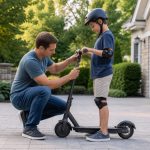
For a smaller or first-time rider: prioritize a scooter under about 20 pounds, a speed mode below the model’s maximum, and controls the child can rehearse while the power is off. If the child cannot squeeze the brake firmly or turn the bar without shifting the whole body, the scooter does not fit.
For a growing household: an adjustable handlebar helps only if the minimum and maximum positions both place the grips near the rider’s waist-to-hip area with relaxed elbows. Payload is a hard limit, but it does not prove the deck and controls fit. Measure height, stance, and hand reach.
For an experienced older rider: resist jumping straight to a 15–20 mph commuter model. More weight increases stopping effort and makes a stalled scooter harder to maneuver. A lower speed ceiling, visible display, predictable brake, and replaceable parts usually deliver more value than a bigger motor.
Parent checklist before buying
- Measure the rider’s height and weight in shoes and normal riding clothes.
- Confirm the child can operate the brake and throttle without changing grip.
- Prefer an adjustable or correctly sized bar instead of guessing from age.
- Verify UL 2272 certification for the exact model and charger combination.
- Choose a private, dry, flat practice area and check local age rules.
- Budget for a properly fitted helmet and pads before accessories or lights.
Safety, Charging, and First-Ride Rules
Start with the age and readiness checks, not a birthday alone. A child should already demonstrate reliable balance, braking, scanning, rule-following, and impulse control on a kick scooter or bicycle. Use the slowest available mode and a flat, dry, private area away from cars, pedestrians, slopes, water, and loose gravel.
The CPSC advises riders to wear a properly fitted helmet. The agency also says compliance with the applicable UL electrical-system standards can substantially reduce micromobility fire risk. Confirm the exact scooter—not merely the brand—has a traceable certification, use only the supplied or manufacturer-approved charger, and follow our charging safety guide. Never charge while the household is asleep or when nobody is present.
Before every session, squeeze the brake, inspect the tires, check the folding latch and fasteners, confirm adequate battery charge, and remove dangling clothing or bag straps. One rider only. Both hands stay on the bar. Stop riding if the battery, charger, plug, or deck becomes unusually hot, swollen, damaged, wet, or gives off an odor.
Frequently Asked Questions
What speed is appropriate for ages 8–12?
There is no universally safe number. Start with the slowest available setting and consider the CPSC guidance cited by the AAP that children ages 9–12 should not operate products faster than 10 mph. The AAP separately recommends no motorized or e-scooter use under 16.
Can siblings share one electric scooter?
They can share only if both riders fall within the manufacturer’s height and payload limits and each can reach the controls. Reset adjustable bars and any speed setting for every rider; never treat the older child’s setup as correct for the younger one.
Is advertised range realistic?
Treat it as a controlled-test ceiling. Rider weight, cold weather, hills, rough pavement, starts, stops, tire condition, and speed reduce real distance. Plan short sessions with enough battery to return without pushing a heavy scooter.
Should I choose solid or pneumatic tires?
Solid tires avoid flats but pass more vibration to the rider. Pneumatic tires can improve comfort and grip on imperfect pavement but need pressure checks and puncture care. Neither makes wet or loose surfaces appropriate.
Final Verdict
For a family comparing the entire 8–12 range, the Segway C2 Pro offers the most useful fit adjustment, but keep its speed restricted and verify the child’s readiness. Choose the lighter C2 Lite when size and carrying weight matter more, or the 7.5 mph GKS Lumios when a slower ceiling is the priority. If the AAP’s under-16 recommendation or your local rules make a powered scooter inappropriate, a well-fitted kick scooter remains the better answer.
Sources: Product details were checked against current pages or manuals from Segway, GOTRAX, Razor, and Hiboy. Safety framing follows the American Academy of Pediatrics and U.S. Consumer Product Safety Commission. Specifications and availability can change; verify the exact model and manual before purchase.