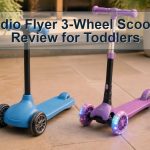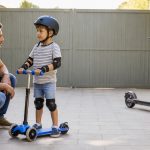
“Razor 3-wheel scooter” can mean four current junior designs with very different controls. The T3 uses tilt-to-turn steering and a rear brake. The Rollie DLX adds a removable seat, adjustable bar, and lights. The folding Kiddie Kick prioritizes simple storage. The Lil’ Kick uses a steel frame and wide deck but does not advertise the same lean-steer system.
Our verdict: the T3 is the clearest standing-scooter choice for a child ready to lean and brake. The Rollie DLX is best only when seated-to-standing conversion will actually be used. Choose the Kiddie Kick for folding, and consider the Lil’ Kick when a conventional fixed three-wheel layout feels more intuitive. Fit and steering readiness matter more than the Razor logo.
Razor 3-Wheel Scooter Comparison
| Model | Age / limit | Key design | Product weight |
|---|---|---|---|
| T3 | 3+ / 48 lb | Tilt-to-turn, 120/76 mm urethane wheels, rear brake | 4.86 lb |
| Rollie DLX | 30 months–4 years / 43 lb | Seat, adjustable bar, tilt-to-turn, light-up wheels/deck | 6.6 lb |
| Folding Kiddie Kick | 3+ / 44 lb | Folding downtube, wide deck, polymer wheels | 6.34 lb |
| Lil’ Kick | 3+ / 44 lb | Steel frame, wide deck, large polymer wheels | 5.2 lb |
Razor T3 · Razor Rollie DLX · Razor Kiddie Kick · Razor Lil’ Kick
Razor T3 — Best Standing Progression
The T3 uses two 120 mm front wheels, one 76 mm rear wheel, a flexible polypropylene deck, and a rear-fender brake. Its tilt-to-turn system teaches weight shift, while the 4.86-pound weight makes it the easiest model here for an adult to carry.
The steel bar is not listed as height-adjustable. Measure the 26.5-inch assembled height and the child’s grip position before buying. The 48-pound capacity is the highest among these four, but a child can outgrow bar geometry before reaching it.
Affiliate link: [AFF-LINK]
Rollie DLX — Best Seated-to-Standing Option
The Rollie DLX covers ages 30 months to four years and converts between a padded seated ride and a standing scooter. The seat and bar adjust, the front wheels illuminate through motion, and three replaceable AAA batteries power deck lights. Standing mode adds a rear-fender brake.
The seat creates a separate fit check: both feet need to reach the ground, and the seat post and lock knob must be fully secure. Its 43-pound maximum and narrow age window mean families should not buy it as a long-term scooter merely because the handlebar adjusts.
Affiliate link: [AFF-LINK]
Folding Kiddie Kick — Best for Storage
The Kiddie Kick combines a three-wheel stance, extra-wide slip-resistant polypropylene deck, steel handlebar, foam grips, and a folding downtube. It weighs 6.34 pounds and supports up to 44 pounds for ages three and older.
Folding is the purchase reason. It also adds a joint that must lock completely before every ride. Razor’s current page does not present adjustable handlebar heights or a rear-brake specification, so do not assume features from the T3 or Rollie transfer to it.
Affiliate link: [AFF-LINK]
Lil’ Kick — Best Conventional Layout
The Lil’ Kick uses a steel frame, padded steel handlebar, extra-wide polypropylene deck, and larger polymer wheels. It weighs 5.2 pounds and carries a published 44-pound maximum for ages three and up.
It is a simple kick-and-go product, but “larger wheels” are not quantified on the current U.S. page. The lack of a published adjustable bar, folding joint, and brake in the specification list should guide expectations. Ask Razor support if a retailer description conflicts.
Affiliate link: [AFF-LINK]
Which Steering Style Fits?
Choose tilt-to-turn when
The child already shifts body weight, follows a boundary, and can learn that twisting the bar is not the main control. T3 and Rollie DLX make this feature explicit.
Choose a simpler fixed layout when
The rider becomes frustrated by lean steering or needs predictable low-speed movement. Inspect the Lil’ Kick or Kiddie Kick in person because their official pages emphasize stability rather than the T3’s named tilt system.
Wait when
The child cannot keep both hands on the grips, cannot stop on command, repeatedly steps into the rear wheel, or runs toward roads and slopes. A third wheel cannot compensate for missing rule-following or brake readiness.
Fit and Growth Limits
Set the grips near waist-to-lower-rib level. The child should stand tall with bent elbows and enough room to push beside the rear wheel. A published age is a screening label, not a fit measurement.
The T3, Kiddie Kick, and Lil’ Kick do not advertise the broad height adjustment found on many premium three-wheel scooters. The Rollie DLX adjusts, but its manufacturer age ends at four. Use our sizing guide and plan for replacement rather than forcing a low bar.
When a Different Brand Makes More Sense
Look beyond Razor when the child needs a published multi-position bar, a higher standing limit, replacement wheels for long-term hand-me-down use, or a wider preschool-to-school-age fit range. A Micro Mini, Maxi, or comparable Globber may cost more but can provide clearer geometry and staged adjustment. Brand familiarity should never outweigh measured fit or the control system a child understands.
Pros and Cons
What works
- Four distinct feature sets cover different beginner needs.
- T3 is light and includes named tilt steering and rear brake.
- Rollie DLX offers a purpose-built seat transition.
- Kiddie Kick folds for storage.
- Razor provides model-specific manuals and support.
What to consider
- Published rider limits cluster at only 43–48 pounds.
- Most bars are not advertised as adjustable.
- Names are easily confused in marketplace listings.
- Polymer and urethane wheels need smooth pavement.
- Three wheels do not prevent falls or collisions.
First-Ride Safety Checklist
- Match the manual to the full model name.
- Inspect bar, grips, deck, wheels, axles, and fasteners.
- Lock the Kiddie Kick fold joint or Rollie seat hardware.
- Teach the model’s steering method at walking speed.
- Confirm brake operation where equipped.
- Stop after a hard impact and inspect again.
Read our two-wheel versus three-wheel guide and family safety guide.
Frequently Asked Questions
Which Razor three-wheel scooter is best?
The T3 is our standing pick, Rollie DLX is the seat-transition pick, and Kiddie Kick is the folding pick. Fit and control can change that answer.
Do all Razor three-wheel scooters turn by leaning?
No. Razor explicitly lists tilt-to-turn for T3 and Rollie DLX. Do not transfer that claim to another model without its manual.
Do all of them have a brake?
T3 and Rollie DLX list rear-fender brakes. The highlighted Kiddie Kick and Lil’ Kick specification lists do not present the same brake feature, so confirm the exact revision.
Which model lasts longest?
The T3 has the highest listed limit at 48 pounds, but fixed geometry may be outgrown first. Measure the bar and deck rather than comparing weight limits alone.
Final Verdict
Buy the T3 for a correctly sized child ready to learn lean steering and a rear brake. Buy the Rollie DLX only when its short seated-to-standing phase has real value. The Kiddie Kick solves storage, while the Lil’ Kick keeps the layout basic. The best Razor 3-wheel scooter is the one whose exact steering, bar, brake, and limits match the child now—not the model with the most features.