Short answer: we do not recommend an electric scooter for a five-year-old. The American Academy of Pediatrics recommends that children under 16 should not operate or ride motorized or e-scooters. A five-year-old is also still developing balance, braking strength, impulse control, hazard scanning, and the ability to follow boundaries consistently.
Some manufacturers market very slow electric scooters to ages four, five, or six. That label describes the company’s intended customer and product dimensions; it does not make powered riding medically appropriate, legally permitted, or safe for every child. For most families, a correctly fitted three-wheel or two-wheel kick scooter is the better next step.
Why Age Five Is Too Early for Our Recommendation
A motor adds acceleration without the physical effort that naturally limits a kick scooter. It also adds battery weight, charging risk, and a control sequence the child must manage while balancing. Even a 6 mph scooter can travel roughly nine feet in one second before reaction and braking distance are considered.
Five-year-olds vary, but buyers cannot solve developmental uncertainty by choosing a slower listing. A child may operate the throttle correctly several times and still forget to brake when surprised by a dog, curb, sibling, or driveway. Direct adult supervision lowers risk but does not eliminate it.
What the AAP and CPSC Guidance Means
The AAP recommends no motorized or e-scooter use under 16. The CPSC emphasizes helmets, protective equipment, safe riding practices, and compliance with applicable electrical-system standards. Those are minimum risk controls, not an endorsement for preschool or kindergarten riders.
Safer Alternatives for a Five-Year-Old
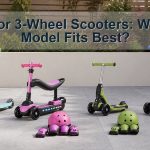
- A correctly sized three-wheel lean-to-steer kick scooter for a child still developing balance.
- A lightweight two-wheel kick scooter only after the child can glide and brake reliably.
- A balance bike with correctly adjusted seat height for children working on steering and balance.
- Short practice sessions in a flat, dry, enclosed area away from vehicles and pedestrians.
- A properly fitted helmet, knee pads, elbow pads, and closed-toe shoes every session.
Check a correctly fitted nonmotorized alternative: [AFF-LINK]
The best alternative depends on measured height, deck fit, bar height, braking reach, and skill. Our kids scooter size guide explains those checks, while the two-wheel versus three-wheel guide covers the handling tradeoff.
Readiness Skills to Build First
- Stops a kick scooter at a marked line without stepping off early.
- Looks left, right, and behind without swerving.
- Keeps both hands on the bar and eyes ahead.
- Follows an immediate stop command every time.
- Avoids slopes, wet areas, loose gravel, driveways, and pedestrians.
- Puts on and keeps on correctly fitted protective gear without bargaining.
Passing these skills does not cancel the AAP recommendation. It simply builds a safer foundation for kick-scooter use now and a future powered decision when the child is older.
If You Already Own a Kids Electric Scooter
- Keep it powered off and inaccessible to the child.
- Store the key, app access, and charger under adult control.
- Do not let an older sibling carry the five-year-old as a passenger.
- Inspect the battery and charger for damage, swelling, heat, or odor.
- Use the exact manufacturer-approved charger and never charge while asleep.
- Consider returning, exchanging, or storing the product until a later family review.
A Better Progression for This Year
Instead of treating waiting as “no scooter,” give the child a measurable nonmotorized progression. Begin with a correctly fitted three-wheel kick scooter if balance is still developing, or a light two-wheel model if the child already glides and uses a rear brake confidently. Keep the route flat, dry, enclosed, and free from driveways.
Use short sessions and one skill at a time: straight gliding, stopping at a marked line, looking over each shoulder without swerving, steering around widely spaced cones, and responding immediately to an adult stop command. Move to the next skill only after the current one is repeatable on more than one day.
- The handlebar sits near waist-to-lower-chest height without raised shoulders.
- Both feet fit the intended stance without hanging over the deck.
- The child can reach and use the brake without changing grip.
- The child stops before the line rather than jumping off after it.
- Helmet, pads, and closed shoes stay on for the whole session.
- An adult controls the practice area and ends the ride before fatigue.
This progression creates useful evidence for future decisions without exposing a five-year-old to motor acceleration, a heavy battery platform, or charging risk. Recheck fit as the child grows and keep the electric scooter readiness guide as the later decision framework.
Frequently Asked Questions
What about a scooter limited to 6 mph?
Six mph is slower than many models but can still cause a serious fall. Speed does not resolve the AAP age recommendation, developmental limits, local law, or battery and charging risks.
Does three wheels make an electric scooter safe?
No. Three wheels improve low-speed standing stability but do not prevent tipping, collisions, head injuries, or mistakes with throttle and brakes. A nonmotorized three-wheel scooter is the more appropriate comparison.
Can a parent hold the scooter while the child rides?
Holding the stem can interfere with steering and does not reliably control acceleration or a fall. It also places the adult off balance. Use a powered-off control demonstration instead.
When should we reconsider an electric scooter?
Revisit the question when the child is substantially older, has strong kick-scooter or bicycle skills, can follow safety rules consistently, and meets local law. The AAP’s current recommendation remains no e-scooter riding under 16.
Bottom Line
For a five-year-old, choose a correctly fitted nonmotorized scooter or balance bike, a properly fitted helmet, and direct supervision. The developmental and medical case for waiting is stronger than the marketing case for a small powered scooter.
Research basis: Specifications were checked against current manufacturer pages or manuals. Safety framing follows the American Academy of Pediatrics and the CPSC Micromobility Safety Center. Availability and specifications can change; verify the exact model, label, and manual before purchase.