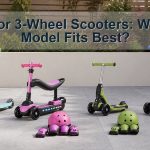
Radio Flyer currently groups two different learning styles under its three-wheel scooter range. The My 1st Scooter Sparkle uses an extra-wide, fixed-feeling beginner platform with a limited turning radius. The newer Flyer Glider Jr uses lean-to-steer control, an adjustable handlebar, a rear brake, and motion-powered light-up wheels.
Our verdict: choose the My 1st Scooter when a small two- to five-year-old needs a simple first platform and fits its fixed 27-inch height. Choose the Glider Jr when the child is ready to steer by leaning and needs handlebar adjustment. Neither is automatically right because it has three wheels; foot reach, steering response, brake access, and current availability all matter.
Radio Flyer 3-Wheel Scooter Comparison
| Feature | My 1st Scooter Sparkle | Flyer Glider Jr |
|---|---|---|
| Published age | 2–5 years | 2–5 years |
| Weight capacity | 50 lb | 44 lb |
| Product weight | 4.85 lb | 6.5 lb |
| Steering | Specially limited turning radius | Lean-to-steer |
| Handlebar | Fixed overall height listed at 27 inches | Adjustable |
| Wheels | Two front, one rear | Motion-light front wheels, high-performance bearings |
| Brake | Rear foot brake | Rear foot brake |
| Current product state | Shown out of stock | Shown unavailable |
Official My 1st Scooter specifications · Official Flyer Glider Jr specifications
My 1st Scooter: Best for Simple First Rides
The My 1st Scooter’s defining feature is its extra-wide base. Radio Flyer describes two front wheels, a clear kick path, and a turning radius designed for beginner control. At 4.85 pounds, it is light enough for most adults to reposition, and its 50-pound ceiling provides a clear upper boundary.
The fixed size is the main limitation. A body height of 27 inches does not reveal the grip height from the deck, so measure the actual scooter if buying used. A child whose hands sit near the chest or whose knees contact the bar has outgrown it even below 50 pounds.
Flyer Glider Jr: Best for Lean-to-Steer Progression
The Glider Jr uses the modern two-front-wheel lean system. Its adjustable handlebar can follow growth, and the motion-powered front lights add fun without a charging cable. Radio Flyer also lists a rear brake, upgraded bearings, and tool-free assembly.
Lean steering asks the child to shift weight rather than rotate the bar. That is useful skill development, but it can frustrate a rider accustomed to tricycle steering. Start with the steering response at walking speed. The Glider Jr is 1.65 pounds heavier and has a lower published capacity than the My 1st Scooter.
Fixed Steering vs Lean-to-Steer
| Observation | Better starting design | Reason |
|---|---|---|
| Child needs a predictable limited turn | My 1st Scooter | Beginner-focused turning radius |
| Child already shifts body weight | Glider Jr | Lean-to-steer progression |
| Growth adjustment is essential | Glider Jr | Adjustable handlebar |
| Adult carries the scooter often | My 1st Scooter | 4.85-pound weight |
| Child cannot operate rear brake | Neither yet | Stopping readiness is missing |
How to Check Toddler Fit
Hands and shoulders
Grips should sit near the waist to lower ribs. The child should hold both grips with relaxed shoulders and slightly bent elbows. Avoid a bar near the face or a stance that forces the child to bend deeply.
Deck and push path
The standing foot should fit flat while leaving the rear brake visible. The pushing shoe must clear the wide front base and rear wheel. Practice slow alternating pushes before a long glide.
Brake reach
With hands forward, the child should slide one foot back and press the fender without twisting around. If every stop ends with a jump-off, continue low-speed practice in a protected area.
Ride Quality and Best Surfaces
Both designs are for smooth, dry pavement. Small urethane wheels can stop abruptly at gaps, gravel, sticks, and raised sidewalk edges. Three contact points improve stability at rest but do not make rough surfaces forgiving.
Motion lights on the Glider Jr are decorative visibility close to the ground. They do not illuminate a route. Keep toddler sessions in daylight, away from driveways, roads, slopes, pools, stairs, and crowds.
Parts, Used Purchases, and Availability
Radio Flyer’s parts store lists scooter parts by model, including Model 525 My 1st Scooter components. That is useful when a wheel or hardware bag is missing, but it also makes the model number important. A color name or broad product title is not enough.
For a used scooter, find the model label, check for recalls, download the correct instructions, and inspect the deck, steering stops, bar, wheels, axles, brake, and all fasteners. Reject cracked plastic, missing hardware, a bent bar, or repairs made with unrelated parts.
Who Should Skip These Radio Flyer Models?
Skip both when the child already rides a two-wheel scooter confidently or needs a bar above the preschool range. The My 1st Scooter is especially easy to outgrow because the bar is not listed as adjustable. The Glider Jr is not ideal for a child who refuses lean steering or already approaches its 44-pound ceiling.
Current availability is another reason to pause. A discontinued or unavailable color can be harmless, but a seller charging a collector-style premium without a warranty or correct parts path offers poor value. Do not substitute a similarly named used scooter until its model label, capacity, assembly guide, and brake layout are verified.
Pros and Cons
What works
- Two beginner approaches instead of one generic design.
- Low product weights for adult carrying.
- Rear foot brakes on both highlighted models.
- Glider Jr adds adjustment and lean steering.
- Official model-specific parts catalog supports ownership.
What to consider
- Current direct availability is inconsistent.
- My 1st Scooter does not offer growth adjustment.
- Glider Jr’s 44-pound limit is relatively low.
- Small wheels need very smooth surfaces.
- Three wheels do not replace helmet use or supervision.
Affiliate link: [AFF-LINK]
First-Ride Safety Checklist
- Confirm the model number and correct assembly guide.
- Check bar, grips, deck, wheels, axles, and rear brake.
- Set the Glider Jr bar near waist level.
- Teach the selected steering method before adding speed.
- Practice ten slow stops inside a marked boundary.
- Recheck fit and hardware after every growth spurt or impact.
Use our kids scooter fit guide, wheel-layout comparison, and safety guide.
Frequently Asked Questions
What age is a Radio Flyer three-wheel scooter for?
Both models reviewed here list ages two to five, but measured fit, steering control, braking, and direct supervision decide readiness.
Do Radio Flyer scooter wheels light up?
The Flyer Glider Jr has motion-activated light-up wheels. The My 1st Scooter Sparkle name refers to its finish, not the same lighting system.
Can the handlebar be adjusted?
The Glider Jr lists an adjustable bar. The My 1st Scooter page gives fixed body dimensions and does not list bar adjustment.
Can I buy replacement parts?
Radio Flyer maintains a model-number parts catalog. Availability varies, so check the exact model before buying used or counting on a future repair.
Final Verdict
The My 1st Scooter is a light, simple introduction for a small rider who fits its fixed geometry. The Flyer Glider Jr is the stronger growth choice for a child ready to lean, brake, and use an adjustable bar. Because current stock is inconsistent, do not pay a premium without checking the model, warranty, manual, and replacement parts.