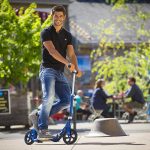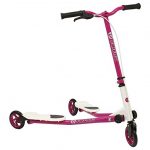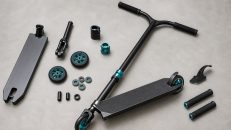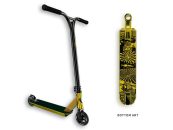
The best stunt scooter is the one that fits the rider and the type of riding they actually want to learn. A light, compact park complete can feel quick in the air, while a wider street setup gives more room for grinds and a calmer platform underfoot. Neither is automatically better. The wrong bar height, deck size, or compression system can make an expensive scooter feel worse than a modest complete that fits correctly.
For a developing park rider, our best overall recommendation is the Envy Prodigy X One. It combines a 5-by-19.5-inch deck, 120mm wheels, IHC compression, and a 7.4-pound build without becoming unusually small. The Root Industries Type R Pro is the clearer first serious stunt scooter for a younger beginner. For street-focused riders who need more deck space, the NATIVE Stem offers four genuinely different sizes instead of one compromise.
Best Stunt Scooters: Quick Picks
- Best overall park complete: Envy Prodigy X One — a balanced intermediate/advanced park setup with a 5-inch deck, 120mm wheels, and manageable 7.4-pound weight.
- Best first serious stunt scooter: Root Industries Type R Pro — published rider-height range, 100kg limit, 110mm wheels, IHC, and a 12-month warranty.
- Best lower-cost young-rider option: Madd Gear Carve Pro-X — compact 30-inch total height, 4-inch deck, and 7.2-pound complete for riders six and older.
- Best lightweight park alternative: Lucky Prospect 2025 — about 7 pounds with aluminum bars, IHC, a 5-inch park deck, and 110mm hollow-core wheels.
- Best advanced park complete: Root Industries Invictus V3 — taller 35-inch setup, 5.2-by-20.5-inch deck, 120mm wheels, and a 7.5-pound build.
- Best beginner street complete: NATIVE Stem — Small through XL sizing, SCS compression, and street-oriented deck choices from 4.75 to 6 inches wide.
- Best premium wide-deck complete: Tilt Theorem 6.5 — 6.5-by-22.5-inch deck, SCS, 30-by-120mm wheels, and documented compatibility for future changes.
Stunt Scooter Comparison
The figures below are manufacturer specifications, not our measurements. Total height is more useful than bar height when comparing complete scooters, but brands do not always report both. Deck dimensions alone also do not show usable foot space, dropout shape, concave, or balance. Use this table to eliminate obvious mismatches, then read the full fit and riding-style sections.
| Model | Best for | Height and weight | Deck | Wheels / compression | Main tradeoff |
|---|---|---|---|---|---|
| Madd Gear Carve Pro-X | Younger beginners and lower budgets | 30-inch total height; 7.2 lb; 220 lb published limit | 4 inches wide; compact youth-oriented platform | Alloy-core wheels; compression type not stated on current page | Limited published dimensions and less room to grow |
| Root Type R Pro | First serious park complete | 32.2-inch total height; 7.5 lb; 220 lb limit | 4.9 × 19.6 inches | 110 × 24mm; IHC | Compact park geometry will not suit taller street riders |
| Envy Prodigy X One | Overall park progression | 34-inch total height; 7.4 lb | 5 × 19.5 inches | 120 × 26mm PU on 24mm cores; IHC | Aluminum bars demand correct use and inspection |
| Lucky Prospect 2025 | Lightweight park riding | 24.5-inch bars; about 7 lb | 5 × 19.5 inches | 110mm hollow-core; IHC | Some colorways have limited or changing availability |
| Root Invictus V3 | Taller advanced park riders | 35-inch total height; 7.5 lb | 5.2 × 20.5 inches | 120mm Honeycore; HIC | Premium lightweight parts cost more to replace |
| NATIVE Stem | Beginner street progression | 30.7–37.2-inch total height; 7.3–8.8 lb by size | 4.75 × 19.5 to 6 × 22 inches | 110 or 115 × 24mm; SCS | You must choose the correct size; variants differ substantially |
| Tilt Theorem 6.5 | Premium street and hybrid riding | 40-inch total height; 9.8 lb | 6.5 × 22.5 inches | 30 × 120mm; Stage I SCS | Too tall, wide, and heavy for many younger park riders |
How We Chose These Pro Scooters
We did not rank stunt scooters by price, color, or marketplace review count. We started with the questions that determine whether a complete is useful: Who is the rider? How tall are they? Are they learning park tricks, street tricks, or both? What deck and bar size supports that use? Can a buyer identify the compression, wheels, brake or fender, and replacement parts?
We then checked official product pages for total height, bar dimensions, deck dimensions, weight, wheel size and width, compression type, material, intended rider, load limit when published, warranty, and current availability. Brands report these details unevenly. We call out missing information rather than filling gaps with retailer copy.
- We rewarded: useful sizing choices, clear component specifications, replaceable wear parts, established compression systems, realistic beginner positioning, and manufacturer support.
- We penalized: vague product identity, folding mechanisms on “stunt” models, plastic wheels, no clear parts path, oversized setups sold to small riders, and pages that hide basic dimensions.
- We treated cautiously: strength superlatives, “pro” labels, age ranges without height guidance, ABEC numbers, maximum load as a fit claim, and temporary sale prices.
- We did not invent: personal ride tests, durability results, trick performance, customer experiences, or impact ratings.
A complete scooter can be excellent and still rank low for your rider. Use our stunt scooter size guide to measure first, then return to the recommendations that match the result.
1. Envy Prodigy X One — Best Overall Park Stunt Scooter
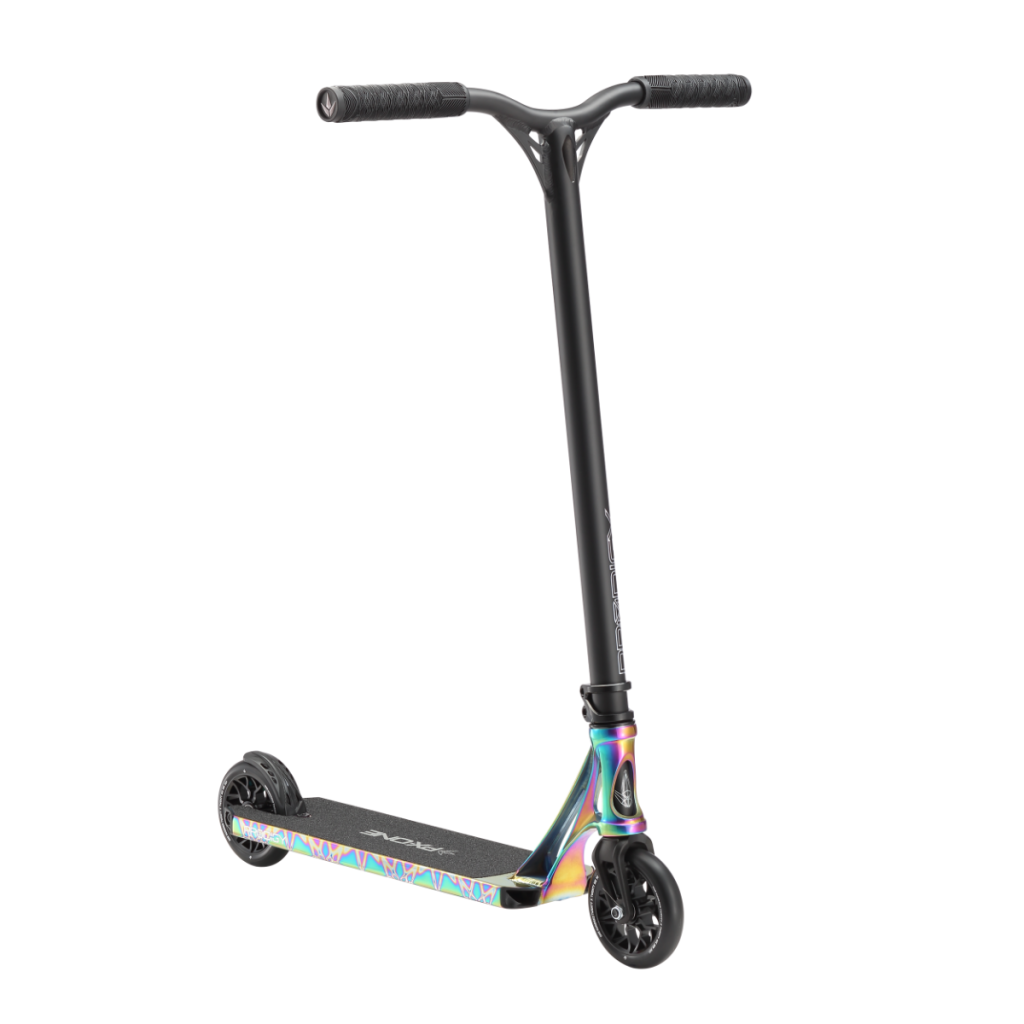
The Prodigy X One is our best overall park recommendation because its dimensions sit in a useful middle ground. A 5-inch deck gives more landing room than a narrow entry-level platform without moving into street-deck bulk. The 19.5-inch length remains compact enough for a rider who wants quick rotations. Its 34-inch total height also works for a broader group than the smaller youth completes, although fit still has to be measured.
Envy pairs the deck with 120mm wheels using 26mm polyurethane around a 24mm core. Larger wheels can hold speed through transitions and offer more polyurethane than a typical 110-by-24mm setup. They do not make rough streets safe, and the wheel, fork, deck spacers, and brake still need to agree on size. The exact X One specification is the reference—not a generic “120mm-compatible” label.
The IHC system and two-bolt clamp keep the park-oriented front end relatively simple and light. That is useful when the rider values whip and overhead-trick response. It also means future bar changes must respect IHC diameter, slit, and clamp requirements. Buying an oversized steel or titanium bar because it looks similar can create an incompatible stack.
The aluminum Reaper-style bars are a meaningful part of the weight saving. Aluminum bars should be used within the manufacturer’s intended setup and checked carefully after hard landings. A rider who repeatedly bends or damages bars should not assume another lightweight bar is the answer; riding style, fit, landing quality, and a qualified shop assessment matter.
What we like
- Balanced park deck width with compact length.
- Current X One generation has a detailed official specification page.
- 120mm wheels suit riders who want speed through park transitions.
- IHC system and aluminum bars keep the complete relatively light.
- Envy lists model-specific hardware and replacement components.
What could be better
- No single official rider-height range replaces measuring the 34-inch complete.
- Park deck and aluminum bars are not the natural choice for repeated street abuse.
- 120-by-26mm tires use a wider PU profile but not a wider 30mm core.
- Some finishes cost more without changing fit.
Best suited for: An intermediate park rider who fits a 34-inch complete and wants a current, light, upgradeable setup.
Skip it if: The rider needs a small first complete, a wide street deck, tall steel bars, or SCS compatibility from the box.
Source: official Envy Prodigy X One page. Match dimensions across the exact colorway before ordering.
2. Root Industries Type R Pro — Best First Serious Stunt Scooter
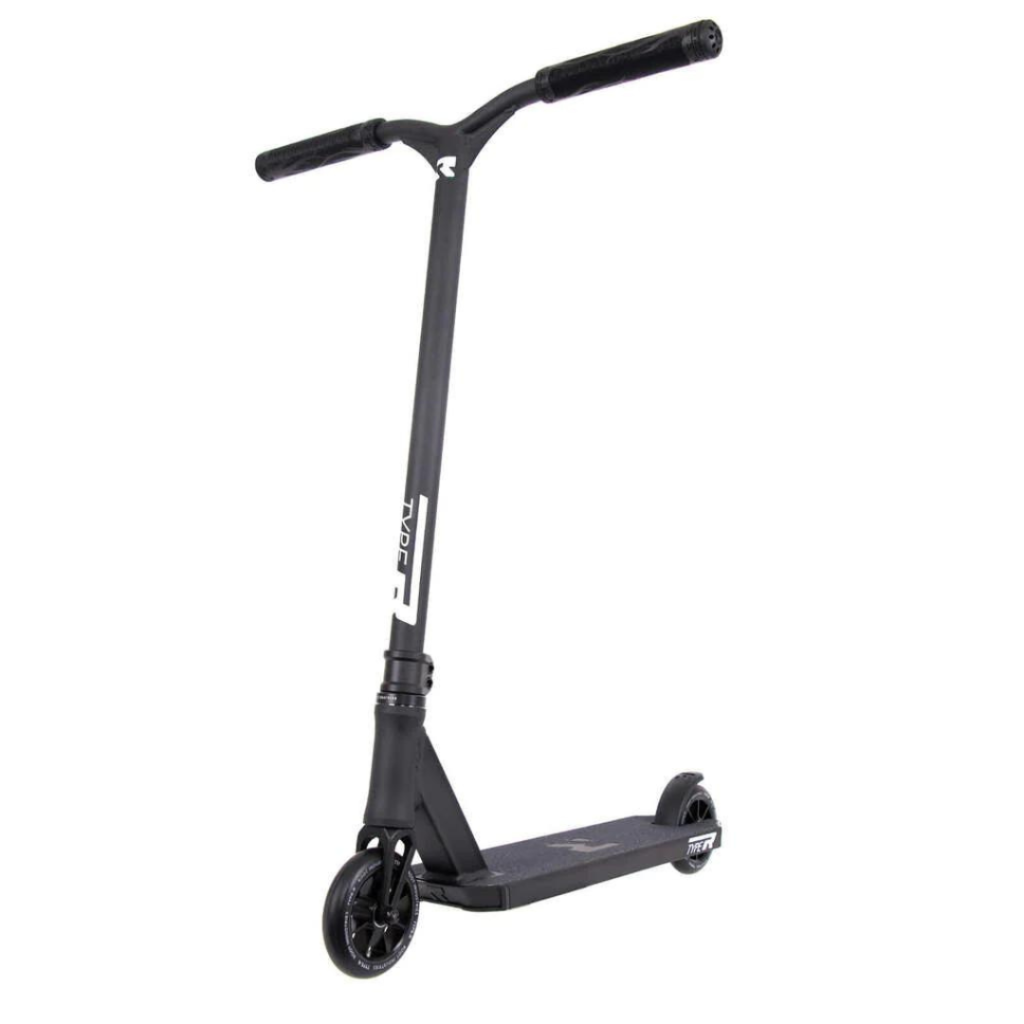
The Type R Pro is our first choice for a younger rider moving from a folding recreational scooter to a real one-piece stunt complete. Root publishes more fit information than most brands: intended age, rider height, total height, load limit, deck, bar, wheels, compression, and warranty. Those numbers let a parent reject a poor fit before color or price takes over the decision.
The 4.9-by-19.6-inch deck is firmly park-oriented but not unusually narrow. It gives a new rider reasonable foot space while keeping the complete at about 7.5 pounds. Chromoly steel bars add a different durability/weight balance from the aluminum bars on the Envy and Lucky picks. They are not indestructible, but a conservative steel bar is a sensible feature on a beginner complete that will see imperfect landings.
Root’s 110-by-24mm wheels are a common modern size. That makes the riding feel and future replacement decision easier to understand than a proprietary wheel. The IHC system is also common on compact park builds. Still, buyers must match the bar diameter, slit, clamp, fork, compression shim, headset, and wheel clearance when changing anything.
A 220-pound structural limit does not mean the scooter fits every rider below that number. A tall rider can be far under the limit and still feel hunched on a 32.2-inch complete. Conversely, a very small child may struggle with the 7.5-pound weight and deck length even if the age label begins at six. Height, strength, stance, and control matter together.
What we like
- One of the clearest official fit and specification pages in this shortlist.
- Chromoly bars and aluminum-core wheels are appropriate for a serious first complete.
- Common 110mm wheel and IHC park configuration.
- Published 12-month warranty is longer than several competing complete warranties.
- Useful middle-size deck for younger park progression.
What could be better
- The age range is broad; the stated rider-height range is the more useful filter.
- Compact geometry is not suitable for taller or street-focused riders.
- Nylon brake and deck inserts are wear items that need inspection.
- A complete sold as beginner-through-pro should still be reassessed as skills and impacts grow.
Best suited for: A rider within the published height range who is learning skatepark basics and needs a dependable first non-folding complete.
Skip it if: The rider is taller than the fit range, wants a wide box-ended street deck, or needs a full-size adult street setup.
Source: official Root Industries Type R Pro page.
3. Madd Gear Carve Pro-X — Best Lower-Cost Young-Rider Pick
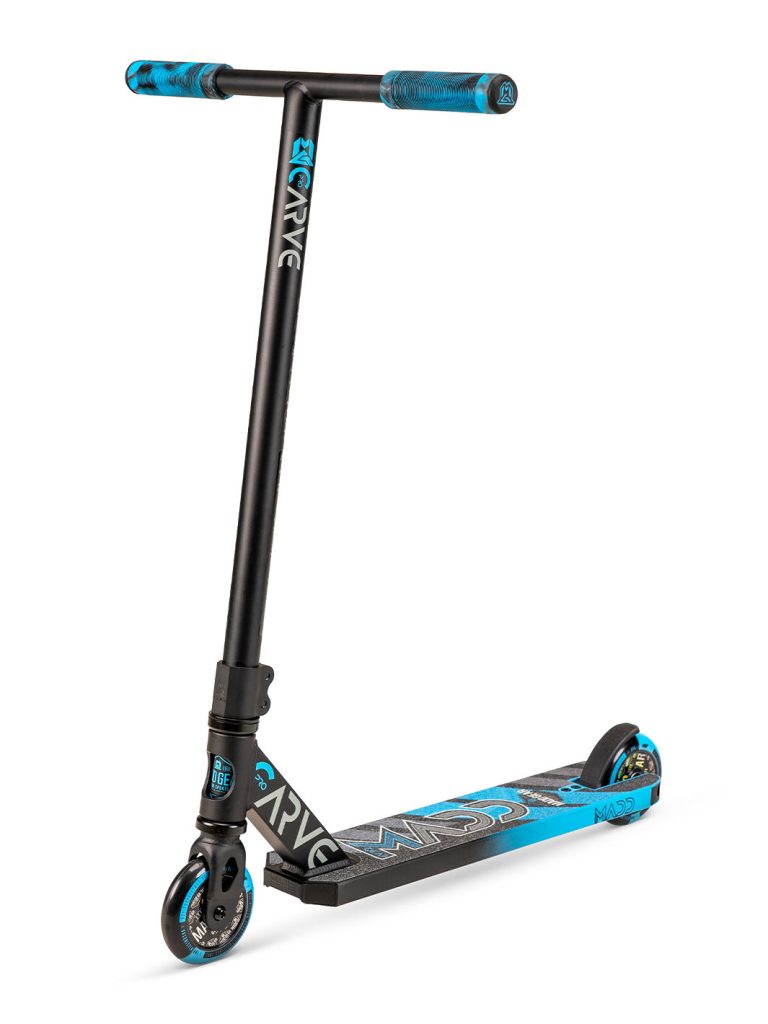
The Carve Pro-X fills a different role from the premium completes. It is a compact first stunt scooter for a younger rider who needs one-piece construction and alloy-core wheels but may not need an advanced aftermarket component list. Its 30-inch total height and 4-inch deck make that positioning clear.
This is where fit discipline matters. A small complete can be easier for a smaller rider to steer and lift, but it can become cramped quickly. Measure the intended grip height and compare the 30-inch total height with the rider’s natural hand position. Do not buy it for a tall rider simply because the published load limit is 220 pounds.
The 6061 aluminum deck and one-piece headtube separate the Carve Pro-X from cheap folding scooters presented as trick models. A one-piece T-bar and double clamp also remove the play that a height-adjustment mechanism introduces. That does not make the complete suitable for every impact or skill. The current page does not publish the same level of wheel-size, bar-dimension, compression, and compatibility detail as Root, Envy, NATIVE, or Tilt.
That missing detail shapes our recommendation. Buy this as a complete that fits now, not as the foundation for an ambitious custom build. Before planning wheels, bars, or compression changes, ask Madd Gear or a qualified scooter shop for the exact model-year specification.
What we like
- Compact dimensions address a real young-rider fit need.
- One-piece deck/headtube and T-bar are more appropriate for tricks than a folding toy scooter.
- Alloy-core wheels are preferable to plastic-core wheels for repeated park use.
- Low complete weight is manageable for many smaller riders.
- Often positioned below premium completes without pretending to be a tall street setup.
What could be better
- Current official page omits important bar, wheel, deck-length, and compression dimensions.
- Four-inch deck can feel narrow as the rider grows or changes style.
- Age six-plus is not a substitute for readiness, instruction, and fit.
- Less attractive as an upgrade platform without confirmed compatibility data.
Best suited for: A smaller beginner who fits a 30-inch complete, rides with supervision, and needs a straightforward first trick scooter.
Skip it if: The rider is already tall, wants street grinds, or plans immediate component changes.
Source: official Madd Gear Carve Pro-X page.
4. Lucky Prospect 2025 — Best Lightweight Park Alternative
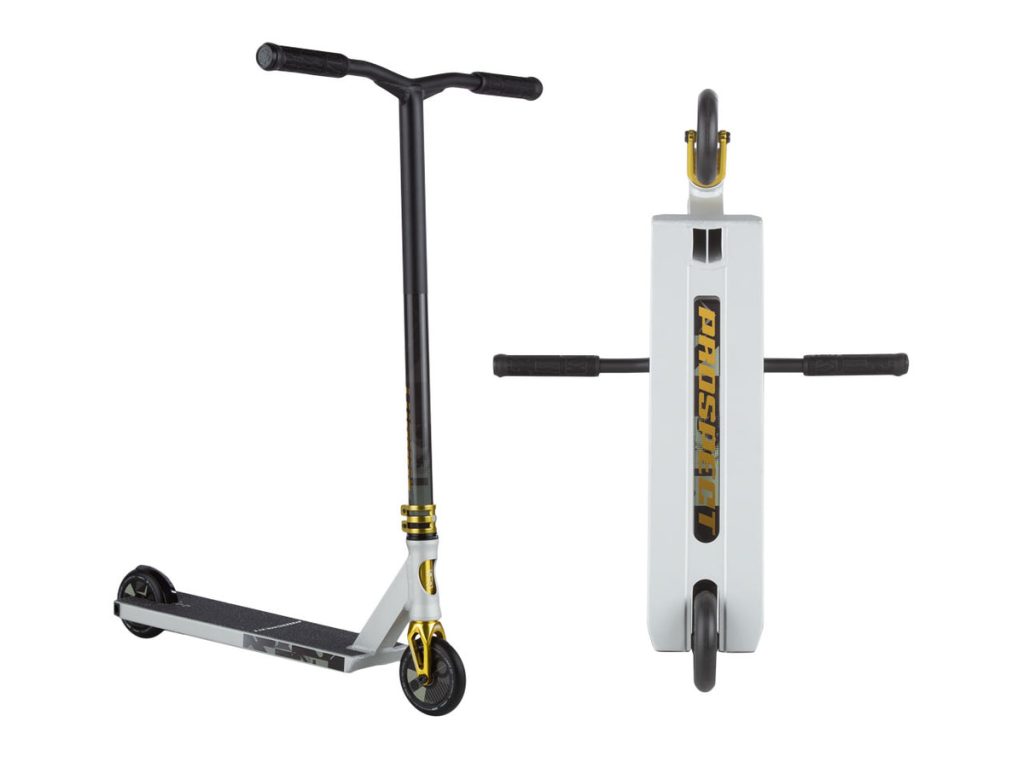
The 2025 Lucky Prospect is for a rider who values a light, compact park complete and prefers 110mm wheels. Its 5-inch deck is wider than older Prospect generations listed in the ForScooter archive, while the 19.5-inch length keeps the familiar park footprint. That generation distinction matters: do not copy specifications from a 2017, 2019, 2022, and 2025 Prospect as if they are one product.
The aluminum bar and IHC fork are designed around low weight. The 110mm hollow-core wheels also prioritize a lively park build. Compared with the Envy Prodigy X One, the Lucky uses smaller-diameter wheels and a similar deck footprint. A rider who likes quick response may prefer that; someone who wants more roll speed through larger transitions may lean toward the Envy’s 120mm wheels.
Lucky positions the Prospect across a very wide skill range. We would narrow that claim. A true beginner can ride it if the complete fits, but the price and lightweight parts are easier to justify for a rider already committed to park sessions. An advanced rider should judge the bar material, deck size, brake, and landing demands against their real use rather than treating “advanced” as an impact guarantee.
Availability is the practical weakness. The official Talus product page was sold out when checked, while Lucky’s 2025 collection and other colorways may change. Use the exact model-year page as the specification reference, then verify seller and warranty eligibility.
What we like
- About 7 pounds in a 5-inch-wide current park complete.
- Clear deck, bar, fork, wheel, compression, brake, and warranty details.
- 110mm hollow-core wheels support a responsive park character.
- Established Prospect line with an official parts ecosystem.
- Natural current alternative to the site’s older Lucky Prospect review.
What could be better
- Current colorway availability is inconsistent.
- 180-day warranty is shorter than Root’s published 12-month Type R warranty.
- Aluminum bar is not the obvious choice for every heavier-impact rider.
- Buyers must distinguish the 2025 deck and wheel spec from earlier generations.
Best suited for: A measured park rider who wants a light 110mm complete and can obtain the correct 2025 generation from an authorized seller.
Skip it if: Availability is unclear, the rider needs a tall steel street setup, or the short warranty is a concern.
Source: official Lucky Prospect 2025 Talus page.
5. Root Industries Invictus V3 — Best Advanced Park Complete
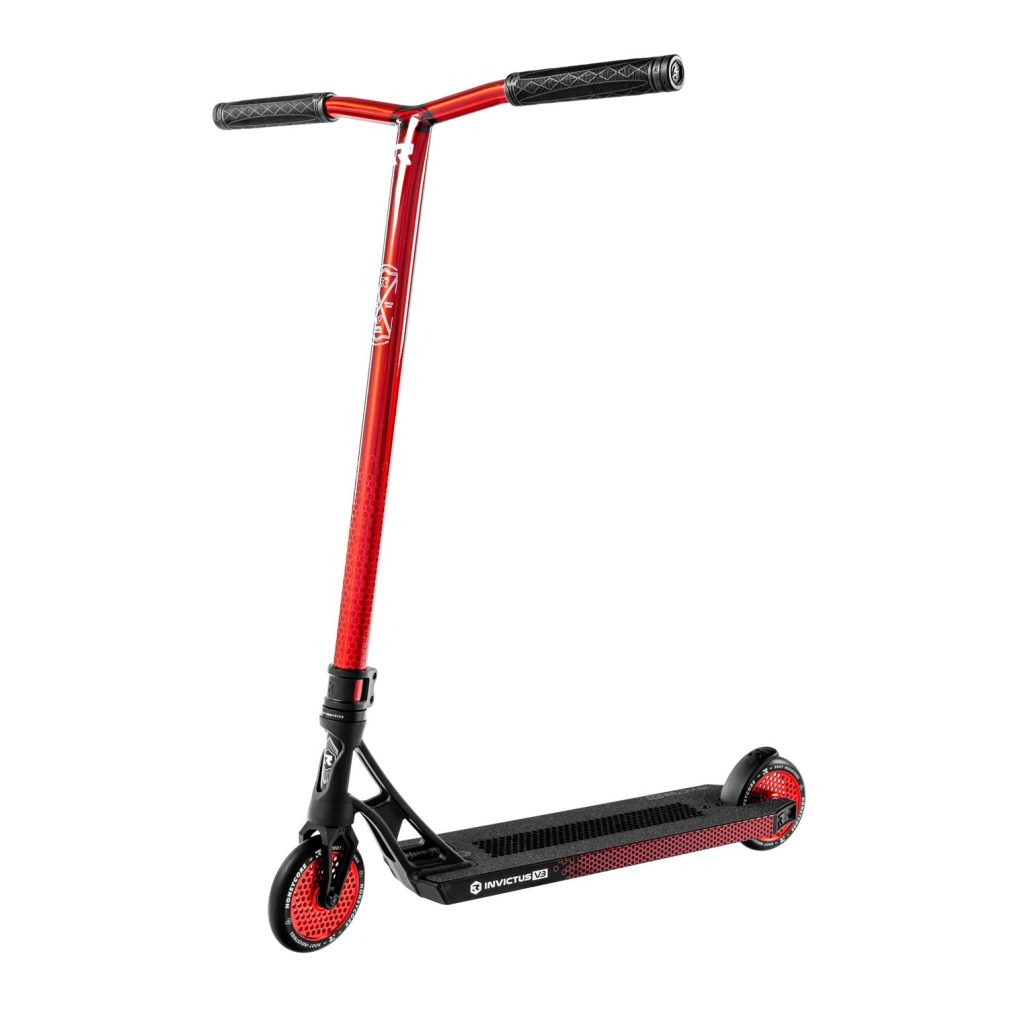
The Invictus V3 is the park recommendation for a taller, more experienced rider who has outgrown compact youth geometry but does not want a heavy street complete. It reaches 35 inches overall and expands the deck to about 5.2 by 20.5 inches while staying around 7.5 pounds. That is a difficult combination to achieve without premium materials and aggressive weight-saving design.
Root’s Chromolite bars are a triple-butted steel-alloy design intended to reduce weight while preserving a steel-like response. The 120mm Honeycore wheels also target park speed and low rotating weight. These features explain the Invictus price better than graphics do. They also create higher replacement costs if a premium component is damaged.
The deck is still park-first. It is wider and longer than the Type R Pro but much smaller than the Tilt Theorem or large NATIVE Stem. A rider moving toward long ledges, crooks, and repeated street grinds may prefer flat box ends and six-plus-inch width. A rider focused on transitions, airs, whips, and a balanced catch platform may find the Invictus dimensions more appropriate.
Do not buy this solely as a growth scooter for a small beginner. Tall bars and a longer deck add leverage and room only when the rider can control them. Root’s own size guide places the Invictus above the Type R models. Measure ground-to-grip height and let present stance outweigh the hope that the rider will eventually grow into it.
What we like
- Taller park geometry without moving to street-complete weight.
- 5.2-inch deck offers more landing room than compact beginner decks.
- 120mm wheels and premium lightweight components suit advanced park speed.
- Official page provides detailed dimensions and materials.
- Useful progression step above the Type R range.
What could be better
- Premium weight-saving parts raise purchase and replacement cost.
- Still not a full-size street deck for riders who prioritize long grinds.
- Manufacturer strength language should not be treated as a guarantee against damage.
- Too tall for many children even when they are below the load limit.
Best suited for: A taller intermediate or advanced park rider who can explain why a light 120mm setup helps their current riding.
Skip it if: The rider is still learning basic control, needs a small first complete, or is committed to wide-deck street riding.
Source: official Root Industries Invictus V3 page.
6. NATIVE Stem — Best Beginner Street Stunt Scooter
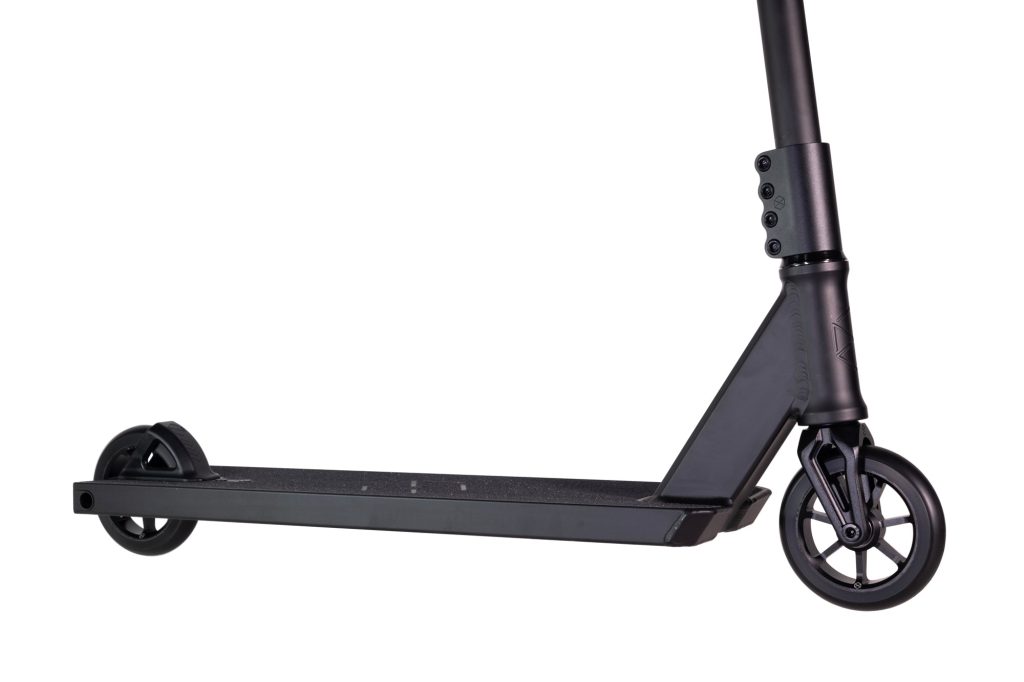
The NATIVE Stem solves a problem most complete scooters ignore: “beginner” riders are not one size. A smaller child learning street basics and a tall adult returning to scootering cannot use the same deck and bar. NATIVE offers Small, Medium, Large, and XL versions with meaningful changes to total height, deck width, deck length, wheel diameter, and weight.
That range makes the Stem our best beginner street recommendation. The Small is closer to a compact complete, while the XL uses a 6-by-22-inch deck and 37.2-inch total height. Medium and Large sit between those extremes. Instead of buying an oversized street scooter “to grow into,” a rider can choose the version that supports their current stance and foot space.
Every size uses SCS compression. SCS is heavier than a minimal IHC setup, but it provides a strong, well-understood platform for standard or oversized compatible bars without requiring a bar slit in a conventional setup. Exact clamp, bar diameter, fork length, headset stack, and shim requirements still matter.
The brake/fender difference deserves attention. Medium, Large, and XL list a fixed fender, while Small lists a brake. A fixed fender is not used like a conventional flex brake. Riders must be able to slow and stop safely in the actual riding area; parents should not assume every stunt complete has the same braking behavior. Follow NATIVE’s current setup instructions and local skatepark rules.
What we like
- Four real sizes cover a much broader rider range.
- Street-focused deck progression from 4.75 to 6 inches wide.
- SCS compression provides a logical base for later compatible changes.
- Official page publishes dimensions and weight for every variant.
- Small and XL are not treated as the same scooter with a different color.
What could be better
- Choosing the wrong variant defeats the main advantage.
- Larger sizes are heavier and less responsive for park-style rotations.
- Fixed fender on Medium through XL changes stopping expectations.
- International shipping, tariffs, stock, and local service can affect value.
Best suited for: A beginner or returning street rider who wants SCS and can choose a measured Small, Medium, Large, or XL setup.
Skip it if: The rider wants the lightest possible park complete or cannot confirm which size and stopping setup is appropriate.
Source: official NATIVE Stem complete page.
7. Tilt Theorem 6.5 — Best Premium Wide-Deck Complete
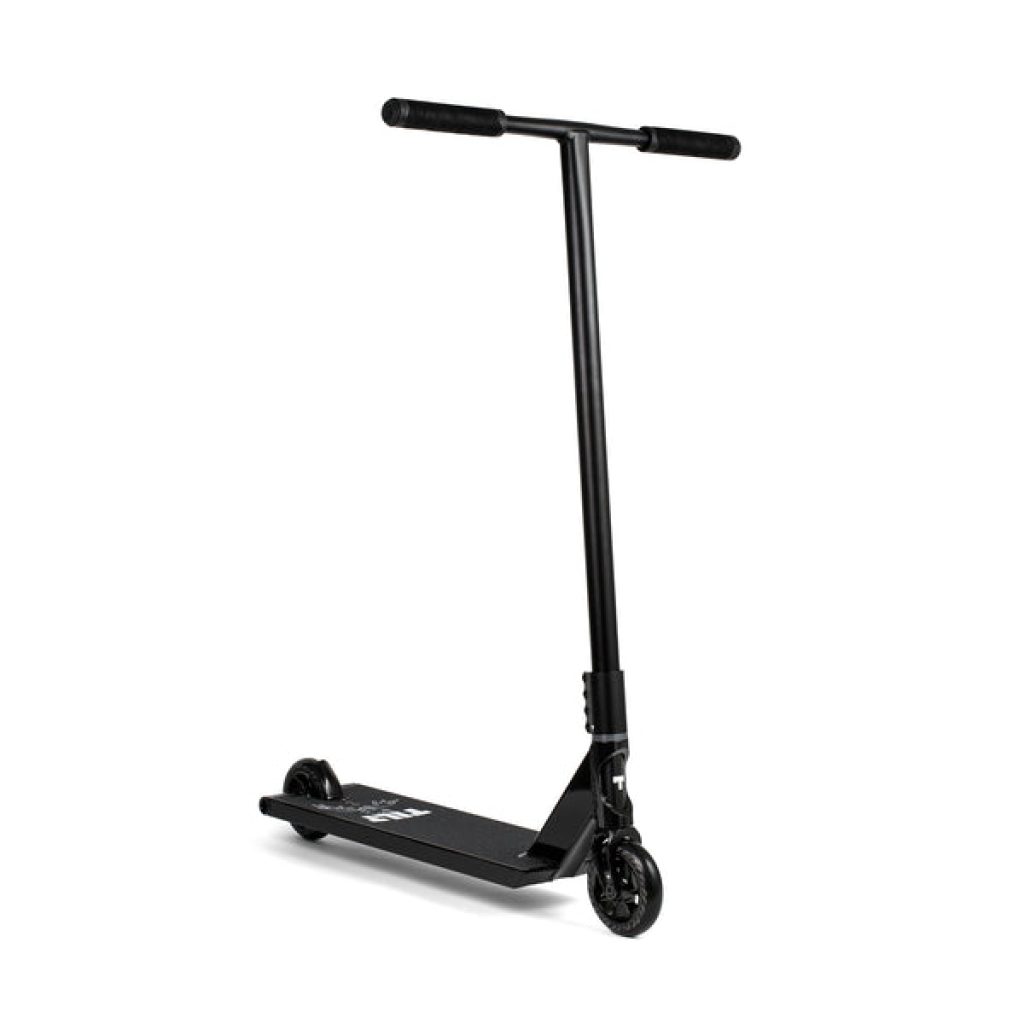
The Tilt Theorem 6.5 is the most substantial complete in this guide. Its 6.5-inch-wide, 22.5-inch-long deck and 40-inch total height target a rider who needs adult-scale street geometry. It gives far more platform for grinds, manuals, foot placement, and taller stance than a youth park complete. It also weighs 9.8 pounds, which changes how quickly it rotates and how demanding it feels.
Tilt documents the Theorem’s compatibility unusually well. The page identifies bar diameter, compression hardware, headset, fork steerer, axles, spacers, bearings, and wheel range. That information is valuable even if the rider never builds a custom scooter. Wear parts and later changes can be matched to a known system rather than guessed from photos.
The 30-by-120mm wheels are wider than the 24mm-core wheels on most picks. A wide contact setup can feel planted and maintain speed, while the 120mm diameter suits flowing through larger obstacles. It adds rotating mass compared with lightweight park wheels. Again, riding style decides whether that is a benefit.
Although Tilt says the complete can suit a rider starting out or upgrading, we would not make it the default first scooter for a child. The total height, deck size, and weight must fit. For a tall teenager or adult learning street riding, the stable platform may be exactly right. For a small park beginner, it can make basic hops, steering, and carrying unnecessarily difficult.
What we like
- Wide, flat, box-ended deck is built around real street use.
- Tall complete gives adult and taller riders a serious option.
- Detailed compatibility list supports maintenance and future changes.
- SCS, common headset/bearing standards, and wheel range are clearly documented.
- Complete uses named Tilt hardware rather than anonymous components.
What could be better
- At 9.8 pounds, it is noticeably heavier than the park picks.
- Forty-inch total height is unsuitable for many younger riders.
- Premium price only makes sense when the street geometry is useful.
- Wide wheels and deck are not the fastest choice for every park trick.
Best suited for: A tall street or hybrid rider who wants a premium complete with a wide deck and documented compatibility.
Skip it if: The rider is small, focused on lightweight park tricks, or cannot control a 9.8-pound full-size setup.
Source: official Tilt Theorem 6.5 page.
How to Choose the Best Stunt Scooter for the Rider
1. Measure the rider before comparing brands
Have the rider stand in normal shoes with shoulders relaxed and elbows slightly bent. Ask them to hold their hands where a comfortable grip would sit, usually around the hip-to-waist area for many stunt riders. Measure from the ground to that hand position. Then compare it with the complete scooter’s total height, not just the raw bar height.
Total height includes the wheel, deck, headset, fork, and bar position. A 24-inch bar does not produce a 24-inch complete. Brands may measure bars from different points, so ground-to-grip height is the most useful complete-to-complete comparison when published.
Personal preference shifts as skills develop. Some park riders prefer slightly lower bars for leverage and rotations; some street riders prefer taller bars for an upright stance. “Lower” and “taller” still need boundaries. Bars that pull the rider into a deep hunch or strike the body during steering are not a smart growth plan.
2. Count deck width, length, and usable foot space
A deck is not just a place to stand. Width changes landing room, grind surface, and control. Length changes stance space, wheelbase, manuals, and rotation. Usable foot space can be shorter than total deck length because the headtube, brake or fender, and rear shape occupy part of the platform.
Compact park decks in this guide run roughly 4 to 5.2 inches wide and 19.5 to 20.5 inches long. They tend to be lighter and quicker to move around the rider. Street decks range from about 5.25 to 6.5 inches wide and can reach 22.5 inches or more. They offer more grinding surface and foot room but add mass and leverage.
Do not treat a wide deck as automatically stable or a narrow one as automatically advanced. A rider with small feet may control a compact deck more naturally. A tall rider in larger shoes may need more room before trick style even enters the discussion.
3. Decide between park, street, and hybrid geometry
Park riding typically rewards lower total weight, compact decks, lighter bars, and responsive wheels. Street riding often rewards taller bars, longer and wider flat-bottom decks, box ends, SCS, and a build that feels settled on ledges and rails. Hybrid completes try to balance both.
Ask where the rider spends most sessions and which three skills they are working on now. If the answer is flyouts, airs, whips, and transition lines, start on the park side. If the answer is manuals, ledges, 5-0s, crooks, and rails, start on the street side. If the rider is new and unsure, choose fit and serviceability before chasing an extreme geometry.
4. Understand bar material and dimensions
Steel or chromoly bars are common because they offer a familiar strength and flex balance, but they add weight. Aluminum bars reduce weight and suit park builds, yet they must be used with the correct compression, clamp, slit, and manufacturer limitations. Titanium bars can reduce weight in larger sizes but are expensive and still require exact compatibility and inspection.
Width affects leverage and clearance. Very wide bars can slow barspins, strike the rider, or conflict with park rules. Bars can sometimes be cut by a qualified shop, but cutting is not reversible and can affect grip space, bar ends, slit, warranty, and compression. Do not cut before confirming the complete fit and manufacturer’s guidance.
5. Match the compression system, not the acronym alone
IHC, HIC, SCS, and ICS describe different ways of keeping the headset and fork compressed. The acronym does not guarantee that any two parts fit. You still need bar outer and inner diameter, slit/no-slit requirement, fork steerer length, compression hardware, headset stack, clamp size, and sometimes a shim.
IHC commonly appears on light park completes with standard-size aluminum or steel bars. HIC uses an oversized bar and compression shim. SCS clamps the bar and compresses the fork without a conventional slit, creating a strong but heavier assembly. Read our stunt scooter parts and compatibility guide before buying any upgrade.
6. Compare wheels as a complete system
Wheel diameter affects speed, clearance, and acceleration. Wheel width affects contact and fit. Core width and polyurethane width may differ, as on Envy’s 120-by-26mm polyurethane around a 24mm core. Fork, deck, spacers, axle, bearings, and brake or fender clearance must all support the wheel.
Most current completes here use 110, 115, or 120mm wheels. Larger is not always better. A smaller wheel can feel quick and light; a larger wheel can carry speed. Hollow-core and cutout designs reduce weight but do not remove the need for crack, de-bonding, flat-spot, and bearing checks.
ABEC ratings are often overemphasized. They describe manufacturing tolerances under a standard, not the complete quality, sealing, lubrication, load behavior, or real-world speed of a scooter bearing. Brand support and correct installation matter more than chasing the highest printed number.
7. Brake, fender, and stopping practice
Many stunt scooters use a rear flex brake that presses on the wheel. Some street completes use a fixed fender intended mainly to prevent foot contact with the wheel, not to function like the same brake. Check the exact product page and teach the rider how that setup is meant to slow and stop.
A brake can heat the wheel and wear polyurethane. A bent or misaligned brake can rub. A fender can loosen or be mistaken for a brake. Practice low-speed stopping in a clear area before entering a park, and never rely on dragging a shoe as the only stopping plan.
8. Check rider weight without using it as a fit chart
A maximum user weight is a structural limit under manufacturer conditions. It does not tell you whether the bars reach the right place, the deck fits the rider’s shoes, or the rider can control the complete. Stay below the limit with a margin and judge fit separately.
Stunt riding produces dynamic loads far above standing body weight. No load number means unlimited drops, bad landings, grinding damage, or continued use after bending. Follow the manufacturer’s intended use and inspect after impacts.
9. Buy support and parts, not just a color
Before ordering, find the exact manual or assembly instructions, warranty, return policy, dealer, parts page, and service contact. Identify the replacement grips, bar ends, wheels, bearings, brake or fender, axles, spacers, and headset parts. If the product page cannot tell you which model generation you are buying, pause.
Marketplace listings frequently mix old photos and new specifications. Match the SKU, colorway, deck dimensions, wheel size, and component names to the manufacturer page. Save a copy of the listing and receipt. A low price on an obsolete version can still be good value, but only when the fit, condition, and parts path are understood.
Complete Stunt Scooter vs Custom Build
A complete is the right choice for most beginners and many intermediate riders. The deck, bar, fork, headset, compression, clamp, wheels, spacers, axles, and brake are selected as one system. Assembly is usually limited to installing and aligning the bar, then checking hardware according to instructions.
A custom scooter makes sense when the rider can name the exact limitation in the current setup. Examples include needing a taller bar for a measured stance, a wider deck for a specific street progression, a supported wheel size, or a stronger compatible compression configuration. “Pro riders use it” is not a compatibility requirement.
- What exact fit or riding problem does the new part solve?
- Is the bar standard or oversized, and does it need a slit?
- Which compression system, shim, clamp, and fork are being used?
- Does the fork and deck support the wheel diameter, width, and axle?
- Does the brake or fender clear the proposed wheel?
- Will cutting or modifying a part affect heat treatment or warranty?
- Who will assemble and verify the finished scooter?
A qualified scooter shop can save money by preventing a stack of nearly compatible parts. Bring the complete scooter and the exact proposed components. Photos and brand names alone are not enough for critical dimensions.
First-Session Setup and Inspection
Most completes arrive partly assembled. “Ready to ride” can still require the bar to be installed, aligned, and tightened. Read the instructions before opening every hardware bag. Use the specified tool and tightening pattern; do not add threadlocker or substitute bolts unless the manufacturer instructs it.
Static setup
- Confirm the exact model and size against the order and product label.
- Inspect the deck, headtube, welds, fork, bars, clamp, wheels, brake/fender, and axles for shipping damage.
- Install the bar fully and evenly, align it with the front wheel, and tighten clamp bolts in the specified sequence.
- Check that the headset rotates smoothly without binding, knocking, or vertical play.
- Spin both wheels and check for axle movement, rubbing, damaged polyurethane, or bearing noise.
- Verify grips are secure and bar ends fully cover the hollow ends.
- Test the brake or learn the fixed-fender setup before riding.
Low-speed proof ride
Use a dry, level, traffic-free area where scooter riding is allowed. Practice pushing, coasting, turning, stepping off, and stopping before attempting a hop. Listen for new clicking, rattling, scraping, or movement. Recheck the clamp, compression, axles, and brake after the initial short session according to the instructions.
Do not begin on a tall ramp because the scooter carries a “pro” label. Build from flat-ground control to small features with appropriate coaching and park etiquette. The purpose of the first session is to confirm fit and assembly, not to test the product’s failure point.
Stunt Scooter Safety and Protective Gear
Stunt scootering involves falls. Protective gear cannot make a trick safe, but it can reduce some injury risk. The U.S. Consumer Product Safety Commission recommends scooter riders—especially children—use a helmet plus knee and elbow pads, check handlebars and the steering column, routinely check nuts and bolts, and ride on smooth surfaces away from motor vehicles.
Use a properly fitted helmet suitable for the riding activity and current safety requirements. Replace a helmet after a significant impact or when its manufacturer says it should be replaced. Inspect the shell, liner, straps, buckle, and fit before every session. Knee pads, elbow pads, wrist protection where compatible with grip control, closed-toe shoes, and clothing that cannot catch in wheels or obstacles are practical additions.
A skatepark is shared space. Follow posted rules and flow. Wait your turn, look before entering a line, do not sit on ramps or leave bags on obstacles, and avoid riding closely behind someone. Beginners should use features that match their ability and have appropriate adult supervision or qualified instruction.
Read our full scooter safety guide for pre-ride, riding, and post-ride routines. This article is general product research, not medical advice or a guarantee against injury.
Maintenance That Protects Fit and Compatibility
Stunt scooters experience repeated vibration, landings, and side loads. A short pre-session inspection is more useful than waiting for a loud rattle. Start at the grips and work downward so the routine is consistent.
Before every session
Check grips and bar ends, then inspect bars for bending, cracking, deep gouges, and changes around welds or slits. Check clamp bolts for correct tension and even gaps where applicable. Hold the front brake/fender area or wheel and rock the scooter gently to feel for headset or compression play. Inspect fork, wheel axles, deck, dropouts, brake/fender, griptape, wheels, and bearings.
Stop riding if a crack, bend, sharp edge, repeated loosening, wheel wobble, de-bonded polyurethane, missing bar end, binding headset, or damaged axle appears. Tightening a damaged part is not a repair.
After hard impacts
Let the scooter cool and clean off enough dirt to see the metal. Compare alignment from the front and side. Pay attention to the bar, clamp, headtube, fork, deck neck, dropouts, axles, and wheel cores. A new sound or changed steering feel is a reason to stop and diagnose, not something to mask by overtightening compression.
Cleaning and storage
Use the manufacturer’s cleaning guidance. Avoid directing high-pressure water at bearings and the headset. Dry the scooter after moisture and store it indoors where temperature and humidity are controlled. Water ratings used for electric devices do not apply here; steel hardware, bearings, and bars can still corrode.
Keep a small service record with model, size, purchase date, hardware checks, parts changes, impacts, and recurring problems. When a part is replaced, record its exact dimensions and compatibility. This turns the next repair into a known system instead of another guess.
Common Stunt Scooter Buying Mistakes
Buying by age alone
Two ten-year-olds can differ greatly in height, strength, shoe size, and experience. Manufacturer age guidance is a boundary, not a fit measurement. Use total height, deck room, complete weight, and readiness together.
Choosing a scooter to grow into
Moderate room for growth is reasonable; an oversized complete can reduce control today. A tall bar and wide deck add leverage and mass. Buy for the next period of real riding, not an imagined adult setup several years away.
Confusing a folding kick scooter with a stunt scooter
Height-adjustable and folding mechanisms are useful for transport but add movement and interfaces not intended for repeated trick loads. A serious stunt complete normally uses a fixed one-piece bar and non-folding deck/headtube assembly.
Upgrading before identifying a limitation
A lighter wheel or taller bar will not correct poor technique, loose hardware, or a mismatched deck. Write down the problem, confirm compatibility, and change one variable at a time.
Assuming maximum load equals durability
A 100kg limit does not promise survival under every landing, rail impact, or misuse. Dynamic loads, angle, fatigue, existing damage, and maintenance change the stress. Inspect and follow intended use.
Buying an old generation under a current name
Long-running products such as the Lucky Prospect and Envy Prodigy change dimensions and parts. Match the year or series, SKU, colorway, deck, bar, wheels, and compression to the current product page.
A Parent’s First-Month Progression Plan
A good first month is not measured by how quickly a child reaches the largest ramp. It is measured by whether the rider can control the scooter, inspect it with help, share the park, and finish sessions before fatigue ruins technique. The scooter is only one part of that process.
Week one: control before tricks
Start on flat, dry ground away from traffic and active park lines. The rider should be able to push with either a comfortable dominant stance, coast in a straight line, look over each shoulder without swerving, make wide and tight turns, and stop in a marked distance. Practice stepping off safely on both sides. If the scooter uses a fixed fender rather than a functional rear brake, learn the manufacturer’s intended slowing and stopping method before adding speed.
Use the same short equipment check at the start and end of each session. Ask the rider to say what they are checking: grips, bar ends, bars, clamp, headset, fork, wheels, axles, deck, and brake or fender. A child does not need to perform every repair, but they should learn that a new rattle or loose feeling means stop and tell an adult.
Week two: hops and quiet landings
Once flat-ground control is automatic, work on small two-wheel hops with an instructor or experienced supervisor. The goal is not height. Watch whether both wheels leave and meet the ground together, knees bend, feet remain controlled, and the rider can roll away without steering sharply. Quiet, repeatable landings usually reveal more control than one high attempt.
Keep repetitions limited. Hands, wrists, shoulders, and legs tire, and technique changes before a beginner notices. End the drill when landings become loud, feet move unpredictably, or the rider stops checking the area. More attempts are not useful when control is declining.
Week three: small features and park flow
Introduce only low features that match the rider’s ability and the park’s rules. Learn how to wait outside a line, make eye contact, call a turn when local etiquette uses that system, and exit without crossing another rider. Rolling up and down a gentle bank with control is real progression. A child who understands park flow is safer and easier for other riders to predict.
Do not copy a trick because another child of the same age performs it. Coaching, hours of practice, strength, risk judgment, and equipment differ. Choose the next step from the current rider’s repeatable skills rather than comparison.
Week four: review fit and hardware
After several sessions, reassess the original purchase. Are the grips still near a comfortable height? Does the deck provide enough stance room? Is the scooter’s weight manageable? Are any bolts repeatedly moving? Are wheels wearing evenly? Has the rider developed a clear preference for park or street obstacles?
This is not automatically upgrade week. If the complete fits, stays secure, and supports the current skills, keep riding it. An upgrade should wait until a specific component creates a measurable limitation or requires normal replacement. Progression comes from instruction and controlled practice far more often than from changing parts.
- The rider is missing basic stops, looking down, or entering lines without checking.
- Hands are slipping, legs are shaking, or landings become consistently uncontrolled.
- A helmet or pad has shifted and cannot be refitted correctly.
- The scooter develops a new rattle, headset play, rubbing wheel, loose bar, or changed alignment.
- The surface becomes wet, crowded, poorly lit, or contaminated with gravel and debris.
- Frustration is replacing judgment and the rider keeps repeating a failed attempt faster.
Plan the Real Ownership Budget
The checkout price is not the complete cost of stunt scootering. Set aside money for a properly fitted helmet, pads, closed-toe shoes, park fees or instruction, tools specified by the manufacturer, and normal wear parts. If that total exceeds the budget, choose a less expensive complete rather than removing protective gear or buying an untraceable used scooter.
Grips, bar ends, griptape, wheels, bearings, brakes or fenders, axles, spacers, and headset parts all wear or can be damaged. Their replacement frequency depends on riding hours, surfaces, technique, conditions, product design, and maintenance. There is no honest universal annual cost.
Before buying, make a small parts basket without checking out. Find the exact current replacement wheels, bearings, brake/fender, rear axle, fork axle, deck spacers, grips, and bar ends. Confirm that the seller ships to your location. This exercise reveals whether a brand supports the complete and what a routine repair may cost.
Also read the warranty exclusions. Stunt products are used in a high-impact activity, and warranties often distinguish manufacturing defects from normal wear, misuse, modification, incorrect assembly, or impact damage. A long warranty does not mean every bent or worn part will be replaced. Keep the receipt, serial or product label, packaging until the return period ends, and clear photos from unboxing.
A used complete can be sensible when a knowledgeable adult or shop can inspect it. Ask for the exact model and generation, then check alignment, welds, deck neck, dropouts, bars, slit, clamp, fork, axles, wheel cores, polyurethane, bearings, brake/fender, headset, and all modifications. Walk away from filed cracks, improvised spacers, unknown bolts, missing bar ends, seized hardware, or parts that the seller cannot identify.
Do not value a custom scooter by adding the original retail prices of its parts. Used components have wear histories, and a mixed build is only valuable when every interface is compatible and sound. Pay for verified condition and fit, not a list of brand names.
Frequently Asked Questions
Final Verdict
The Envy Prodigy X One is our best overall park pick because its 34-inch height, 5-inch deck, 120mm wheels, IHC system, and 7.4-pound weight form a coherent current complete. It is not the automatic winner for a small beginner or a wide-deck street rider.
For a younger first-time stunt rider, the Root Industries Type R Pro provides the strongest combination of published fit guidance, common modern components, and warranty information. The Madd Gear Carve Pro-X is the compact lower-cost alternative when its 30-inch height fits.
The Lucky Prospect 2025 is a light 110mm park option, while the Root Invictus V3 gives a taller advanced park rider more deck and wheel. For street progression, the NATIVE Stem wins on size choice. The Tilt Theorem 6.5 is the premium full-size option when a 40-inch, 9.8-pound, wide-deck setup is genuinely appropriate.
Related Stunt Scooter Guides
- Measure stunt scooter bars, deck, wheels, and rider fit
- Understand stunt scooter parts and compatibility
- Read the Lucky Prospect legacy review
- Use the complete scooter safety checklist
- Compare adult kick scooters for commuting instead of tricks
Editorial sources checked August 11, 2026: current official product and sizing pages from Madd Gear, Root Industries, Envy/Blunt, Lucky Scooters, NATIVE, and Tilt; CPSC scooter and helmet guidance; and current ForScooter sizing, parts, and safety resources. Manufacturer performance and strength descriptions remain manufacturer claims. Prices were intentionally not hard-coded.