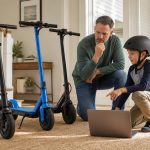
The best 3 wheel scooter is the one that matches a child’s height, steering readiness, and route—not simply the model with the broadest age range. Two front wheels can help a scooter stand while a young rider places a foot, but three wheels do not prevent falls or remove the need to learn braking.
Our overall school-age pick is the Micro Maxi because it weighs only 5.5 pounds, offers a 26.25–35.75-inch bar, and has a roomy 13 × 5.5-inch deck. The Micro Mini is the better small-preschool fit. Globber’s PRIMO, MASTER, and ULTIMUM families add folding, steering locks, longer growth ranges, or higher-capacity geometry for specific families.
Best 3-Wheel Scooters at a Glance
| Model | Published fit | Weight/limit | Key feature | Best for |
|---|---|---|---|---|
| Micro Maxi | Ages 5–12; bar 26.25–35.75 in | 5.5 lb / 110 lb | 13 × 5.5 in deck | Best overall |
| Micro Mini LED | Ages 2–5; bar 19.25–27 in | 4.2 lb / 110 lb | Very low and light | Small preschool riders |
| Globber PRIMO Foldable Lights | Ages 3–7; 95–120 cm | 2.50 kg / 50 kg | Steering lock and fold | Learning plus storage |
| Globber MASTER Lights | Ages 4–14; 100–160 cm | 3.08 kg / 50 kg | Five bar heights | Growth range |
| Globber ULTIMUM | Ages 5–adult; 105–200 cm | 4.62 kg / 100 kg | Adjustable steering angle | Shared family format |
1. Micro Maxi: Best Overall
The Maxi combines two 120 mm front wheels, one 80 mm rear wheel, lean-to-steer control, and a rear brake. Its broad bar range and low product weight are the practical reasons it wins—not a fashionable color. It is easy for an adult to carry and gives a child more deck room than the Mini.
Who should choose it
It suits a school-age rider graduating from a Mini, a cautious child who dislikes low-speed balancing, or a family that values replaceable parts. The standard model does not fold. A confident child seeking conventional handlebar turns may be ready for the two-wheel Micro Sprite instead.
Official specifications: Micro Maxi
2. Micro Mini LED: Best Small Preschool Fit
Micro publishes ages two to five, a 19.25–27-inch bar, 12 × 4.5-inch deck, 4.2-pound product weight, and 110-pound limit. The low bar is more important than the high limit: it lets a smaller child hold the grips without lifting the shoulders or reaching toward the chest.
The LED wheels generate light through motion and need no batteries. Treat those lights as fun, not night equipment. For a child this young, the adult’s first questions should be whether the child stops on a verbal cue and stays inside a physical boundary.
See our detailed Micro Mini review.
3. Globber PRIMO Foldable Lights: Best Learning Features
The PRIMO Foldable Lights is listed for ages three to seven and rider height 95–120 cm. Its three bar positions are 67.5, 72.5, and 77.5 cm. It weighs 2.50 kg, supports up to 50 kg, folds, and uses 121/80 mm polyurethane wheels.
Why the steering lock matters
A beginner can practice pushing and rear-brake placement while the front wheels remain aligned. Once the child is calm and consistent, release the lock to introduce lean steering. The lock is a teaching stage, not a permanent substitute for learning turns.
Official specifications: Globber PRIMO Foldable Lights
4. Globber MASTER Lights: Best Long Growth Range
Globber publishes ages four to fourteen, rider height 100–160 cm, five bar positions from 74 to 94 cm, a 50 kg limit, and 3.08 kg weight. It folds and retains the steering lock. This makes it a more credible long-growth model than a scooter marketed with age alone.
Still measure the child. At the lower end, the child must reach the lowest bar without raised shoulders. At the upper end, the rider must remain below the limit and feel comfortable with a three-wheel deck and lean response. Older riders may prefer a narrower two-wheel platform.
Official specifications: Globber MASTER Lights
5. Globber ULTIMUM: Best High-Capacity Design
The ULTIMUM expands the format to a published age of five through adult, rider height 105–200 cm, and 100 kg limit. It weighs 4.62 kg, folds, and offers six bar positions from 76 to 101 cm. The front wheels measure 125 × 43 mm and the rear wheel 90 × 48 mm.
The unusual steering adjustment
Its steering angle can be adjusted rather than offering only a locked or unlocked state. That can tune how readily the scooter responds to lean, but every rider needs a slow re-familiarization after a change. The broader and heavier chassis is not the best answer for a small child merely because the official range begins at five.
Official specifications: Globber ULTIMUM
What Three Wheels Do—and Do Not Do
They improve standing stability
Two front contact points let the scooter remain upright more easily while a rider steps on. This can reduce the anxious wobble that happens before the first push and lets a child focus on deck stance and brake location.
They usually use lean steering
The handlebar may not rotate like a bicycle fork. The child shifts body weight to curve the front assembly. Some children learn this naturally; others keep twisting the grips and feel stuck. Do not force the bar or modify the mechanism.
They do not prevent tipping
A three-wheel scooter can still tip during a sharp lean, stop at a crack, slide on wet pavement, or travel into a hazard. Wheel count cannot replace a helmet, supervision, surface inspection, or practiced braking.
How to Measure for a 3-Wheel Scooter
- Measure the child from floor to waist in the shoes used for riding.
- Choose a bar setting around waist to lower-rib height.
- Confirm relaxed shoulders and slightly bent elbows.
- Place one foot on the deck without covering the rear brake.
- Check that the child can move the pushing foot to the brake without looking down.
- Stay below the published limit with ordinary clothing and gear.
Use the full kids scooter sizing guide when a child sits between models. Do not buy an oversized scooter for “room to grow”; poor leverage is a present-day control problem.
Foldable vs Non-Foldable
Folding is valuable for transit, small trunks, apartment closets, and school storage. It also adds a joint that must fully lock and be inspected. A non-folding scooter is often lighter and mechanically simpler. The correct choice depends on the weekly routine, not a feature count.
Ask who will carry the scooter when the child is tired. Compare the actual product weights: 4.2 and 5.5 pounds feel quite different from 4.62 kg on stairs. Practice folding away from fingers and never let a child ride with a partly engaged mechanism.
Pros and Cons
What works
- More stable while stepping on at low speed.
- Wide decks and low bars are available for small riders.
- Lean steering encourages smooth body movement.
- Some models add steering locks and useful growth ranges.
What to consider
- Three wheels do not make poor surfaces safe.
- Lean steering may frustrate bicycle-style riders.
- Wide front wheels need more storage space.
- Older confident riders may outgrow the handling before the bar.
Affiliate link: [AFF-LINK]
First-Ride Safety Plan
Before each ride, inspect the bar clamp and buttons, steering assembly, deck, front axles, wheels, rear brake, and folding joint if present. Start with straight pushes and ten stops, then add broad S-turns. Walk across driveways, curbs, slopes, gravel, deep seams, wet leaves, and crowded areas.
Frequently Asked Questions
Is a 3-wheel scooter only for toddlers?
No. Current Micro and Globber models cover school-age children, and the ULTIMUM extends into adult dimensions. Fit and preferred steering matter more than the label.
Are two front wheels better than two rear wheels?
Two-front lean scooters provide a broad steering base without placing extra wheels beside the pushing foot. Designs differ, so brake access and deck stance still need a test.
When should a child switch to two wheels?
Switch when the child balances at low speed, wants conventional steering, and can stop and scan reliably—not on a fixed birthday.
Can a 3-wheel scooter be used on gravel?
These small polyurethane wheels are intended for smooth, dry pavement. Walk loose gravel, potholes, deep gaps, wet surfaces, and other hazards.
Final Verdict
The Micro Mini is the cleanest low-fit choice and the Micro Maxi the strongest overall school-age option. Pick the PRIMO when folding and a learning lock solve real problems, the MASTER when measured growth range matters, and the ULTIMUM only for riders who need its high-capacity geometry. Stability begins with correct dimensions and practiced stopping, not wheel count alone.