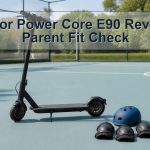
Electric scooters for kids ages 6–8 require the most conservative buying approach in this calendar. Product pages may market powered scooters to this age, but small children vary sharply in balance, braking strength, impulse control, and ability to understand boundaries.
This is a comparison guide, not a statement that motorized riding is medically appropriate. The Globber E-MOTION 4 offers the lowest 3.7 mph learning mode and three-wheel stance, while the Scout Pro caps at 6 mph. The C2 Lite has stronger documentation and longer useful life, but its 9.9 mph maximum must not become the starting point.
Quick Answer
Begin with the AAP’s under-16 recommendation and your child’s readiness. If your family proceeds, compare the 3.7/6.2 mph Globber and 6 mph Scout Pro before faster models. The GKS is a simple 7 mph two-wheel option; the C2 Lite is the most documented choice for a child who fits and already demonstrates stronger skills.
Quick Picks
- Lowest learning mode: Globber ONE K E-MOTION 4.
- Lowest two-wheel maximum: GOTRAX Scout Pro.
- Simple 7 mph option: GOTRAX GKS.
- Best documented growth option: Segway C2 Lite.
Globber ONE K E-MOTION 4 — Three-Wheel Reference
Official specifications: Globber ONE K E-MOTION 4
The Globber leads this narrow comparison because 3.7 mph is the lowest learning mode we found among the documented models, and three bar positions improve fit. It is unavailable direct, so this is a format reference as much as a shopping pick.
Parent check: Verify exact model, stock, charger, and that the child can lean-steer and use both brakes.
Useful strengths
- Two front wheels improve standing stability at very low speed.
- Two modest speed modes support staged practice.
- Three bar heights provide useful fit adjustment.
- Dual braking methods create redundancy.
Real limitations
- Lean-to-steer behavior differs from a bicycle or two-wheel scooter.
- Out of stock at the official U.S. store.
- Three wheels do not prevent falls or remove supervision needs.
Best suited for: A closely supervised child who needs the slowest mode and three-wheel stance.
Affiliate link: [AFF-LINK]
GOTRAX Scout Pro — Slowest Maximum
Official specifications: GOTRAX Scout Pro
The Scout Pro’s 6 mph cap and three-mile range keep expectations modest. It is simpler than buying a faster scooter and hoping the child stays in a low mode.
Parent check: The maker’s 4–7 positioning means many eight-year-olds will be too tall; measure rather than guessing.
Useful strengths
- Six-mph ceiling is the lowest in this shortlist.
- Short range keeps it focused on brief supervised sessions.
- Compact frame avoids adult-scooter bulk.
- UL certification is stated across the GOTRAX kids line.
Real limitations
- Three-mile claim leaves little range margin.
- Small fixed geometry can be outgrown quickly.
- Manufacturer age positioning conflicts with the AAP’s conservative under-16 guidance.
Best suited for: A small six- or seven-year-old whose family proceeds after readiness and medical/legal checks.
Affiliate link: [AFF-LINK]
GOTRAX GKS — Simplest Deck-Control Pick
Official specifications: GOTRAX GKS
The GKS adds range and a 7 mph ceiling while retaining a light frame. Deck activation can reduce abrupt hand-throttle starts but is not intuitive until practiced.
Parent check: Confirm both sensors, minimum rider weight, brake use, and fixed-bar fit.
Useful strengths
- Seven-mph ceiling is easier to supervise than teen models.
- Both-feet deck sequence avoids a hand throttle.
- Light frame is easier to transport.
- Controls are visually simple.
Real limitations
- Deck sensors require their own practice.
- Small solid tires feel firm on rough pavement.
- Fixed geometry may not suit a fast-growing rider.
Best suited for: A child who has already mastered basic kick-scooter balance and can learn the deck sequence.
Affiliate link: [AFF-LINK]
Segway Ninebot C2 Lite — Best Documented Compact Pick
Official specifications: Segway C2 Lite
The C2 Lite has the best documentation and most growth room here, but the 9.9 mph maximum requires active speed management. Its standard mode and display are the useful features—not top speed.
Parent check: Keep it in the lowest appropriate mode and confirm the rider is within 3′8″–4′8″ and 44–110 pounds.
Useful strengths
- Published height and minimum/maximum payload improve fit decisions.
- Three modes include a slower standard setting.
- Seventeen-pound body is manageable for many parents.
- Battery display and clear range test conditions reduce guesswork.
Real limitations
- Fixed bar limits growth.
- Solid tires and no suspension prefer smooth pavement.
- Maximum mode is too fast for a first session.
Best suited for: An older or more skilled child in this range who fits precisely and needs clear specifications.
Affiliate link: [AFF-LINK]
Age Range Is Not a Readiness Test
Before considering power, the child should start, steer, look around, slow, and stop a kick scooter without reminders. They should follow a stop command immediately and stay inside a marked boundary.
A three-wheel stance can steady a child at low speed, but lean steering introduces its own learning curve. A two-wheel model feels more familiar to bicycle riders but requires stronger balance. Neither layout is fall-proof.
Short, closely supervised sessions are appropriate for evaluating control. Extra range is not a benefit for a six-year-old. Low speed, low weight, correct bar height, brake reach, and a dry private surface matter more.
Parent checklist
- Complete the readiness guide before shopping.
- Measure height, weight, hand reach, and stance.
- Select the lowest available speed mode.
- Keep an adult within immediate reach during early practice.
- Use helmet, knee pads, elbow pads, and closed-toe shoes.
- Stop immediately when attention or posture deteriorates.
First-Ride and Charging Rules
Rehearse the throttle, brake, kick-start requirement, and power-off procedure before the motor is active. Begin in the slowest mode on flat private pavement. The rider should stop at a marked line repeatedly, look over both shoulders without swerving, and step off only after the scooter is stationary. One rider only, both hands on the bar, and no phone, earbuds, passengers, darkness, rain, slopes, loose gravel, or traffic.
Confirm UL 2272 certification for the exact electrical system—not merely a similar model. Use only the supplied or manufacturer-approved charger. Charge in a dry, ventilated location away from exits and combustible materials, while an adult is awake and present. Stop using a battery or charger that is swollen, cracked, wet, unusually hot, damaged, or giving off an odor.
Frequently Asked Questions
Should a six-year-old ride an electric scooter?
The AAP recommends that children under 16 not operate or ride e-scooters. Manufacturer labels may begin at six, but they do not replace medical advice, local law, or an individual readiness assessment.
Is 6 mph slow enough?
Six mph can still cause injury. It is easier to supervise than 10–15 mph, but fit, braking, surface, protection, and adult control remain essential.
Are three wheels better for ages 6–8?
They can improve low-speed standing stability. However, lean steering is different, the scooter can still tip, and the child still needs reliable braking and judgment.
How long should a first session last?
Use brief 10-minute practice blocks with frequent stops. End earlier if the child becomes excited, tired, distracted, or starts ignoring boundaries.
Final Verdict
For ages 6–8, the Globber E-MOTION 4 has the gentlest published learning mode, while the Scout Pro offers the lowest two-wheel maximum. The GKS is the simple 7 mph alternative. The safest answer may still be a correctly fitted kick scooter until the child is older and the family is comfortable departing from the AAP’s conservative guidance.
Research basis: Specifications were checked against current manufacturer pages or manuals. Safety framing follows the American Academy of Pediatrics and the CPSC Micromobility Safety Center. Availability and specifications can change; verify the exact model, label, and manual before purchase.